Translate

Showing posts with label Salt Cod. Show all posts

Sunday, April 19, 2015

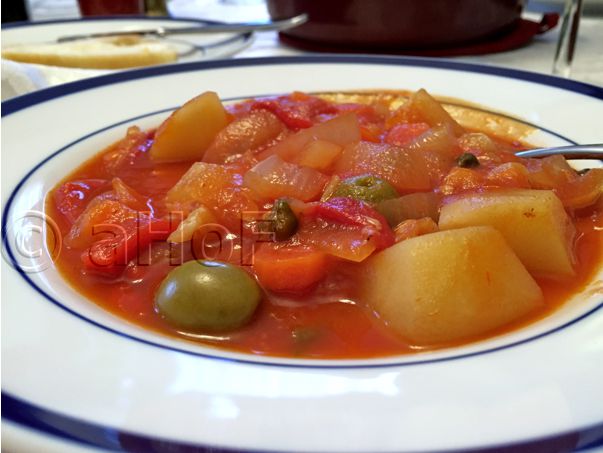
Delicious Fish Stew

Okay, I know many might read this title and think, "What in the world could possibly make a fish stew delicious?" My husband is one of these. And then there are more adventurous people who might just be intrigued. The dish in question is one I learned to make while living in Guatemala, and it was made exclusively for Good Friday. I made this stew every year for Good Friday, once I learned to make it, and I truly looked forward to making it, because I really loved it. Originally, the recipe is called Bacalao a la Vizcaina, or Cod in the style of Biscay (as in Biscay, Spain). In Guatemala, the dish was traditionally made with salt cod. Learning to use salt cod was interesting. Granted I was in my early 20s at the time, and had never heard of salt cod before. 

Bacalao, salt cod, Vizcaya, Biscay, Spain
Bacalao a la Vizcaina

Variations on a Dish from Spain

As with any dish, who makes it will determine how it is made. Even in a small area, each cook will have their own spin put on the "way it should be done." To have a dish from northern Spain, made in Guatemala, one can imagine how far some of the changes might go. And yet, there are still some basic ingredients that stay the same. Salt cod of course, is the basis of this dish, whether in Spain or Guatemala. The use of olive oil, onions and tomatoes to make the sauce is held in common, though even in Spain there is question as to whether the sauce should be made with only red bell peppers rather than tomatoes. In my recipe from Guatemala they added both, and I have noted in looking around the internet that most recipes use both. Some recipes call for potatoes. Some call for olives. Some for garbanzo beans. Still other recipes call for other vegetables such as peas or carrots. The recipe from my ex-in-laws in Guatemala uses potatoes, carrots, capers and even pickled cocktail onions! 
Not endorsing these brands; just using what was on hand!

The Spanish, apparently, use this dish for Christmas and Easter holidays where it often has chorizo sausage added in. This would exclude the dish from strict Catholic Good Friday meals. In my opinion, the dish is certainly a holiday-type fare, with all the little additions I mentioned at the end of the last paragraph, and the fact that it is so very delicious.

On Using Salt Cod

If you have never used salt cod, it is cod that has been dried and salted heavily to preserve. To use salt cod, it must first be soaked in clear water for 2 or 3 days, changing the water daily, to both plump the fish back to its mostly original size and weight, and more importantly to remove the heavy amount of salt, which would make it completely unpalatable otherwise. The salt cod I bought when in Guatemala was sold in a wooden box. It came from Spain or Norway, usually. The fish was rather strongly scented and quite hard. It is set into a casserole or other dish with a lid, covered in water, lid placed on and refrigerated. The next day, it would be removed from the fridge, drained, again covered in clear water, lidded and refrigerated. Next day, this step is repeated, and only on the fourth day was it ready to use in a dish. To make the Bacalao a la Vizcaina for Good Friday, I would start soaking the cod on Tuesday in order to be ready to make the stew on Friday. Even after all this soaking, one never, ever had to add salt to the dish, as there was always a significant amount of residual salt in the fish; enough so to salt the dish perfectly.

My Latest Experience

My Bacalao a la Vizcaina, in the pot
Trying to find salt cod here in the US these days is a far more difficult task. I looked online for hours and was nearly ready to give up altogether. Most places that sold it had prohibitive prices. As if that were not enough, most places had absolutely scathing reviews on the fish. I finally ordered some through Amazon, though it was described as "12 ounces, which would plump up to 1 pound". The boxes I used to get in years prior were a pound of dried fish - VERY dried fish. I am pretty sure, though I never weighed it, that this would plump to something more like 1½-pounds. The "salt cod" that actually arrived on my doorstep this year was already quite wet and slightly plump, though covered in salt. I proceeded to make my Bacalao a la Vizcaina as I always did, soaking the cod for three days, changing water daily. Then, when ready to make the dish, I made the "stew" part, cooking until the vegetables were tender. I cooked the drained fish, covered with another change of fresh water until it could be flaked. After flaking, it was added to the stew just before eating.

I will say, this fish, once reconstituted fully and cooked, seemed to be quite nice. However, my initial misgivings on seeing already partly plumped salt cod were well-founded. This cod was certainly not that fully dried-and-salted sort I'd had in past. As a matter of fact, the stew ended up needing salt added, which in many, many years of making this dish, had never been the case. 

My reasoning, then, is that:
  • If salt cod is nearly impossible to find here,
  • If it is not nearly as "salted" as the salt cod I'd had in past,
  • If I have to add salt to the dish anyway,
  • Then why not just use some nice fresh cod and add salt as I normally would in a dish?

A "Stretchy" Recipe

If you should choose to make this dish, please understand that (at least in Guatemala) this was one of those stews that could be stretched to fit the need. Less vegetables and water were added if the dish was to serve a small family. Lots more potatoes and carrots were added, with more water, if it was to serve a larger crowd. I suggest, if using fresh cod instead of salt cod, to use at least a good 1½ pounds as the least amount. You might add more, if needed, for a larger crowd. The recipe is simplicity itself. Not overcooking the fish is the only thing to be careful of, as overcooked fish is rubbery, at best. The "stew" part of the recipe is the time it takes to cook the vegetables through, no more. The fish is added at the last minute. All that said, I love the reheated leftovers just as much!


Bacalao a la Vizcaina

Bacalao, salt cod, Vizcaya, Biscay, Spain
Bacalao a la Vizcaina

Serves 6 - 10, depending on how one makes the dish

1 pound salt cod, reconstituted, OR
1½ pounds fresh cod (in which case add salt to the stew)
2 - 4 tablespoons olive oil
2 - 3 white or yellow onions
2 - 6 cloves fresh garlic, minced
2 - 3 cans (6 ounce each) tomato paste
4 - 6 cups water
2 - 4 jars (4 ounces each) sliced pimiento, with their liquid
1 small jar green olives (about 15 - 20 olives, drained)
2 - 4 tablespoons small capers, drained
1 small jar cocktail onions, drained (about 15 - 20)
3 - 6 carrots, peeled, sliced in coins a scant ¼-inch thick
3 - 5 medium potatoes, peeled, cubed

If using salt cod, begin 3 days prior: remove salt cod from wrappings, rinse and set into a glass or ceramic casserole with lid. Cover with water, set lid in place and refrigerate. Next day, drain the water, add fresh, cover and refrigerate. Repeat this again next day. On the day of making the stew, Drain the water again, set the fish into a saucepan, cover with water and gently bring to a simmer, cooking until the fish will easily flake when pressed with a fork. Drain, cool slightly and flake the fish. Set aside.

To make the stew: Slice the onions in half, lengthwise and then cut across into 1/4-inch thick half-ring pieces. Heat a stew pot and add the olive oil. Cook the onions in the olive oil gently, stirring occasionally until tender and barely golden. Add the garlic and stir until fragrant. Add in the cans of tomato paste and begin adding water, mixing to make the stew base. Add in the pimiento slices with their liquid, the drained olives, capers and cocktail onions. Add the carrots and potatoes, cover and cook until the vegetables are tender, about ½ hour or 45 minutes. When ready to serve, stir in the flaked fish. Serve with crusty French bread.


My passion is teaching people how to create a harmony of flavors with their cooking, and passing along my love and joy of food, both simple or exotic, plain or fancy. I continue my journey in ethnic and domestic cuisines, continuing my journey to explore diverse culinary experiences and hopefully to start you on a journey of your own. Join me also at A Harmony of Flavors on Facebook, and Pinterest.

Saturday, March 21, 2015

The Things that Come Up When Surfing the Web

It never ceases to amaze me all the things that come up when you are on a search for something online. Invariably, when looking for one particular thing, I end up learning about 3 or 5 others. If I look for one recipe, I end up finding others, equally interesting, but not even close to my search.

Today, I was online searching to find if barley was ever used in an Irish Soda Bread. Apparently it is not, at least as far as my search results came out. Still, I used barley and made another attempt at a Soda bread that came out really great. Along the way in this search, I found a slew of other information. None of which might be of the slightest interest to any readers, but still, just for the record:

  1. I learned that it is possible bicarbonate of soda may have been first created and used in the early Americas! No 100% facts on that, but it was interesting.
  2. Soda Breads are made all over the world, including in Serbia, from where my paternal grandparents haled. 
  3. This in turn led to looking at a site about Serbian Soda Bread and:
  4. Other recipes listed in that site included a cod and potato casserole made for Christmas Eve. My paternal grandmother made a fish and potato casserole (which we all hated) for Christmas Eve also, though it bore little resemblance to the recipe I saw online, which actually sounded very good. 
  5. Thinking of cod in turn led me to the fact that Easter is not far away and I had been meaning to get some dried salt cod to make the recipe for Bacalao a la Vizcaina that is served on Good Friday in Guatemala.
  6. I ended up on various sites looking for dried salt cod, which I eventually ordered, and:
  7. Then since I was ordering things, I also went to Vitacost to place an order I had been putting off for over a week. So the mind works.
I am sure many of you do this same thing, but it just struck me funny today how all over the board my searching ended. And now, of course, I am certainly planning to make the recipe for Bacalao. It may not resemble Spain's version of this dish, but then again, no matter how "authentic" a dish is, it is always changed by imaginative cooks. So, while my recipe uses mainly a can of this and a jar of that, it is also highly tasty. It has been more than 25 years since I made that dish, so I do want to get my own photos into my Guatemalan Cookbook / Memoir I have made for my children.

grandparents, heritage, recipes
Grandma (Tina Makaji Hromish) and Dad
As for the Fish and Potato Casserole of my Grandma's, ("Bakalar s Krumpirom," according to many websites, though I never heard Grandma call her dish by this or any other name): we all hated it, including my Dad, which really surprised me when I found out. I am interested in that casserole from the standpoint of saving and preserving our cultural roots. Just because Grandma's casserole (to be fair, made with a lot of religious restrictions: no meat, eggs, milk or cheese) was unpalatable to us, does not mean it can not be made palatable. As I stated in my previous blog, Grandma's forte was pastries. Her pastries were absolutely the best, ever. Her chicken or beef soup and homemade noodles were a standard, and delicious. My love of saffron comes from Grandma's soup. What I am trying to get at is that I am interested to make some kind of version of her recipe, possibly with better results. Who knows? 

What I do recall about Grandma's casserole was that it contained fish, potatoes, sliced very thinly, and rice. The casserole was never thickened, but had a lot of runny liquid in it. I can still see Grandma in my mind, pulling out the oven rack, lifting the edge of the foil covering the casserole and checking for doneness. I remember vividly watching this with trepidation, knowing I had to eat it soon. Looking back, it seemed like there was just no flavor at all, and this was so rare in Grandma's house. 

Anyway, all that was a long time ago and far gone in all but memory. For now, I do have some salt cod ordered and will soon be making my Good Friday stew. 


My passion is teaching people how to create a harmony of flavors with their cooking, and passing along my love and joy of food, both simple or exotic, plain or fancy. I continue my journey in ethnic and domestic cuisines, continuing my journey to explore diverse culinary experiences and hopefully to start you on a journey of your own. Join me also at A Harmony of Flavors on Facebook, and Pinterest.

Disqus