Translate

Showing posts with label cinnamon. Show all posts

Friday, July 17, 2020

Really Good Desserts and Gluten Free

I am not gluten intolerant. My kitchen is certainly not set up to be gluten free. On occasion, when I have had to bake something for a general audience, some of whom were definitely gluten intolerant, I spent an inordinate amount of time cleaning every single thing in the kitchen that could have come in contact with the recipe. Depending on the severity of the issue, this all may have been for nothing, but I did my level best to accommodate.

I have found that for someone diabetic, as I am, gluten free baking is perilous, as the carb and calorie count are so much higher in all the alternative flours needed. That didn't stop me from trying things out and taste-testing. And truly a lot of the recipes did come out wonderful. They tasted good. The issue I had, and I didn't find out till later, is that I hate the flavor that xanthan gum imparts to baked goods. Apparently it works, doing its magic of acting as a bit of a binder. The taste was objectionable. To me. 

Gluten Free, Brownies
Gluten Free Best Brownies

Once I identified the flavor I objected to as xanthan gum, I quit using it and (as my husband would say) "the world was a safer place." :-)

I settled on a couple of different gluten-free "all-purpose" flour mixtures. One I used was one of Gluten-Free Girl's mixtures, many years ago. Later on I tried to find it again and it seemed to no longer be available on her site. And later still, have found that now one cannot any longer go to her site unless "signing up and joining." I just quit bothering. While I used her mixture, I was less fond of the overall flavors, so I most often used my own mix:


Easy 6 - 2 - 1 Mixture


A great all-purpose gluten free flour mixture is a simple 6-2-1 ratio of:

6 cups brown rice flour
2 cups of potato starch (NOT potato flour!)
1 cup of tapioca starch


~~~~~~~~~~~~~~~~~~~~~~

All that said, I did make many recipes that came out great, or good enough to pass with high marks. Here are three of them that I did make and enjoy. I substituted psyllium husks for the xanthan gum in the recipes and enjoyed the flavor far more. 

I am posting these recipes with the idea that those who might need to eat gluten free also realize that things like sour cream (among many other things) may have wheat in it. Wheat tends to be hidden in the most strange places. 

Keep in mind that gluten free flour mixtures in a batter tend to need a little longer baking time to be done in the center.

Gluten Free, Sour Cream, Coffee Cake
Gluten Free Sour Cream Coffee Cake

Gluten Free Sour Cream Coffee Cake


Makes one 8 x 8-inch cake

⅓ cup unsalted butter, room temperature
1 cup granulated sugar
2 large eggs
1 teaspoon vanilla
1 tablespoon psyllium husks
1½ cups gluten free all-purpose flour of choice
1 teaspoon baking powder
½ teaspoon baking soda
½ teaspoon salt
¾ cup sour cream
⅔ cup pecan pieces
½ teaspoon oil (grapeseed, coconut or whatever you prefer)
1 teaspoon cinnamon
½ teaspoon ground cardamom

STREUSEL:
⅓ cup gluten free all purpose flour of choice
½ cup packed brown sugar
3 tablespoons unsalted butter, room temperature
1 tablespoon psyllium husks
½ teaspoon cinnamon

Preheat oven to 350 degrees. Lightly grease or oil an 8 x 8-inch baking dish and set aside.

Place the pecans in a small bowl and sprinkle on the ½ teaspoon of oil. (I have a baking spray with coconut oil and just used that). Sprinkle on the cinnamon and the cardamom and toss to coat. Set aside.

Cream together the ⅓ cup of butter and the granulated sugar. Add in the eggs one at a time, beating well after each addition. Add in the vanilla and 1 tablespoon of psyllium husks and stir.

Separately, sift or whisk together the flour, baking powder, baking soda and salt. Add this mixture to the creamed mixture in two batches, alternating with the sour cream. Gently fold in the pecans. Pour the batter into the prepared baking pan.

Make the streusel by rubbing together all the streusel ingredients and strew over top of the batter in the pan. Bake for about 40 to 45 minutes, or until a toothpick inserted in the center comes out with a dusting of crumbs.


~~~~~~~~~~~~~~~~~~~~~

Gluten Free, Rhubarb, Coffeecake
Gluten Free Rhubarb Coffeecake

Gluten Free Rhubarb Coffeecake


Makes one 9 x 13 pan

½ cup butter
1½ cups sugar
1 teaspoon vanilla
2 eggs
2 cups gluten-free all-purpose flour mix, of choice
2 teaspoons baking powder
1 teaspoon baking soda
1 teaspoon xanthan gum (or 1½ to 2 tablespoons whole psyllium husks)
½ teaspoon salt
1 cup sour cream
2 cups chopped rhubarb
¾ cup chopped pecans

STREUSEL:
¾ cup gluten-free all-purpose flour mixture of choice
¾ cup brown sugar
4 - 5 tablespoons butter
½ teaspoon xanthan gum (or 1 tablespoon whole psyllium husks)
½ teaspoon cinnamon 


Cake: Preheat oven to 350 degrees. Grease a 9 x 13 inch baking pan and set aside.

Beat together the butter and sugar; beat in the eggs and vanilla. Whisk or sift together the dry ingredients, to combine. Alternately beat in the dry ingredients and the sour cream. Stir in the rhubarb and nuts. 

Streusel: Mix the flour, brown sugar, xanthan gum and cinnamon. Work in the butter until it looks like large crumbs. Sprinkle over the cake. Bake at 350 degrees for 50 to 55 minutes, or until a toothpick inserted in the center comes out clean.

~~~~~~~~~~~~~~~~~~~~~~~~~

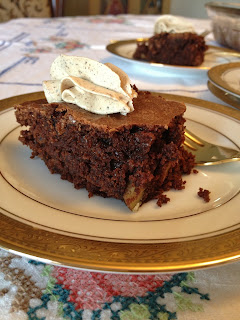
Gluten Free, Brownies
Best Gluten Free Brownies

gluten free, brownies, dessert, recipeBest Gluten Free Brownies


Makes one 8 x 8-inch pan

2 ounces unsweetened chocolate
⅓ cup unsalted butter (5⅓ tablespoons)
1 cup granulated sugar
2 eggs
1 teaspoon vanilla extract
¾ cup Gluten-Free all purpose flour mixture of choice
½ teaspoon GF baking powder
½ teaspoon salt
1 tablespoon psyllium husks
½ cup chopped nuts

Place the chocolate and butter into a saucepan on very low heat and melt the two together. Remove from heat and allow to cool to where the pan does not burn the hand. Add the sugar and beat with a wooden spoon until combined. Mixture will be grainy. Add in eggs, one at a time, beating after each until completely incorporated. Add in the vanilla to combine.

Whisk together in a separate bowl the GF flour, baking powder, psyllium and salt, then add to the mixture in the saucepan. Stir until almost combined, then add the nuts and finish mixing. Place mixture into a greased 8 x 8-inch baking pan and bake at 350 degrees for about 25 - 28 minutes. A tester inserted in the center should come out with slightly moist crumbs; not completely dry. Allow to cool completely before cutting.

NOTES: Chocolate Buttercream Icing would be perfect on these brownies, as well as my Cinnamon Ancho Buttercream, below.


~~~~~~~~~~~~~~~~~~~~~~~~~

Cinnamon, Ancho chili powder, Buttercream
Cinnamon Ancho Buttercream 

Cinnamon Ancho Buttercream


Makes about 2 cups frosting

1 stick unsalted butter, at room temperature
1½ cups confectioners' sugar
1 teaspoon cassia cinnamon
1 teaspoon ancho chili powder
1 teaspoon vanilla

The butter must be at room temperature for this. If it is too cold, it will not combine properly. Place the butter, confectioners’ sugar, cinnamon and ancho chili powder in the bowl of a stand mixer. Start on very low to combine, then increase speed to about medium. Continue to beat for about 8 minutes. Add in the vanilla and beat well to combine.


My passion is teaching people how to create a harmony of flavors with their cooking, and passing along my love and joy of food, both simple or exotic, plain or fancy. I continue my journey in ethnic and domestic cuisines, continuing my journey to explore diverse culinary experiences and hopefully to start you on a journey of your own. Join me also at A Harmony of Flavors on Facebook, and Pinterest.

Thursday, January 17, 2019

My Indian Spice Drawer Part 2

Okay, I got interrupted for the last few days, but I'm back, with the next batch of spices I use (or don't use, as the case may be) in Indian cooking. There are some that are really not used at all, like caraway, even though a recipe may specify "caraway." Instead, it likely means black cumin. Or allspice, which is not, nor ever has been native or grown near India, and yet I have noted some that call for allspice, mainly because allspice's flavor components seem to mimic cinnamon, cloves and nutmeg, which three spices are often used in a Garam Masala spice mixture. Many, many of these spices I am featuring are ones used in other cooking as well, but that happen to be used in Indian cooking. Truly, there are few spices that I haven't used elsewhere, except maybe for the Black Cumin, or Indian Gooseberries.

Here I will continue to show what the spice looks like, in hopes that between good closeup shots and some background info, it will be easier to identify and find the spices you need. For reference of size, each photo is of one tablespoon of the spice or seeds.

Cassia, Cinnamon Bark, spice, thick bark, quills
Cassia Cinnamon Bark

Cinnamon, Cassia 


(Cinnamomum cassia / Cinnamomum aromaticum)

Cassia Cinnamon, the dried bark of the tree, is the most commonly found "cinnamon" in the US. It is far less expensive than True Cinnamon. The two types of cinnamon have similarities, and while technically can be interchangeable, have quite different flavor profiles. An American Apple Pie or Cinnamon Buns, routinely made with Cassia Cinnamon, would just not be the same if made with True Cinnamon. Cassia Cinnamon quills are very thick and difficult to break. They are usually sold in specific lengths, or already ground into powder. They are darker in color and the flavor is darker, stronger and spicier than True Cinnamon. In India, both are used, and the name seems to be the same for either.

Some Indian names for Cassia you may encounter: Dalchini 

~~~~~~~~~~~~~~~~~~~~~~~~~

True Cinnamon, thin bark, quills, spice
True Cinnamon

Cinnamon, True 


(Cinnamomum verum)

True Cinnamon, sometimes called Ceylon Cinnamon, is what is known as “cinnamon” to most of the world outside the US. The quills of True Cinnamon, from the tree’s inner bark, are very thin, usually found with many layers of them all curled together and are very easily crumbled. This also means they are also easily crumbled or ground to a powder in a spice grinder. True cinnamon is lighter in color and its flavor has a slight citrus note to its more delicate flavor and aroma. When making most ethnic dishes calling for cinnamon, look for True Cinnamon to give the dish its most authentic flavor. 

Some Indian names for True Cinnamon you may encounter: Dalchini 

~~~~~~~~~~~~~~~~~~~~~~~~

Cloves, spice, whole spice
Cloves

Cloves 


(Syzygium aromaticum) 

Cloves are the aromatic buds of a tree in the family Myrtaceae, native to Indonesia. Cloves have a sweet, hot and pungent aroma and flavor. If used whole in a dish, they are best removed before eating. Used in many cuisines, cloves also cross the line between sweet and savory foods. They are often used in northern Indian cooking and usually one of the spices used in making Garam Masala. Cloves are a common addition to rich, northern Indian curry recipes. Cloves are also a key ingredient in Masala Chai or other spiced teas. 

Some Indian names for Cloves you may encounter: Laung, Labang, Lavang, Lavangum

~~~~~~~~~~~~~~~~~~~~~~~~~

Coriander Seed, spice, whole spice
Coriander Seed

Coriander Seed 


(Coriandrum sativum L.)

Coriander seeds can easily cross lines between sweet and savory foods, with their slightly citrus aroma and flavor. From the family Apiaceae, the seeds are globular and from 3 to 4 mm in diameter. A native of the Mediterranean, it is commercially produced in many countries around the world. It is a rare Indian recipe that does not call for coriander seeds, from the hottest curry to curry powder to sweets. (Add some to your biscuits or apple pie!) While the coriander plant, most often called cilantro, can also be called coriander, it can become confusing. The green plant is used as an herb and the flavors between herb and seed are not interchangeable.


Some Indian names for Coriander Seed you may encounter: Dhania ke Beej, Dhaniya

~~~~~~~~~~~~~~~~~~~~~~~~~~

Cumin Seed, whole spice, spice
Cumin Seed

Cumin Seed 


(Cuminum cyminum L.)

A small brown seed in the family Apiaceae and native to the Mediterranean, Cumin seeds are most often equated with Mexican cooking, though they are  used extensively in Indian cooking as well, not usually as a predominant flavor, but a homogeneous part of the whole of spices. Cumin seeds are termed bitter and “warm” and earthy. It is a part of the Bengali Five-Spice mixture (Panch Phoron). In Indian cooking, the seeds are most often toasted first, then used whole or ground. If confused with other similar seeds, fennel seeds are larger and greener, and caraway seeds are smaller and darker brown.

Some Indian names for Cumin Seed you may encounter: Safed Jeera, Jira, Zira, Zeera

~~~~~~~~~~~~~~~~~~~~~~~~~

Black Cumin, whole seed, uncommon spice
Black Cumin Seed

Black Cumin Seed


(Bunium persicum / Bunium bulbocastanum / Elwendia persica)

Often called “Caraway,” this is a misnomer, in English. Though from the same family of plants, Apiaceae, Black Cumin is native to Iran and northern India. Its flavor is more complex and milder than regular cumin. Black Cumin seeds are very dark, very small and very thin. Easily distinguished, once compared and used, there is much confusion surrounding this spice that is little known outside of India. Too often, when looking for Black Cumin, instead, one is shown Nigella Sativa (Nigella Seed, Kalonji), which bears no resemblance in either look or smell, nor it is from the same family.

Some Indian names for Black Cumin Seed you may encounter: Kala Jeera (Jira), Shah Jeera (Jira)

~~~~~~~~~~~~~~~~~~~~~~~~~

Fennel Seed, spice, whole spice
Fennel Seed

Fennel Seed


(Foeniculum vulgare)

Another seed from the Apiaceae family, Fennel seeds are larger and greener than cumin seeds, though similar in shape. Native to Europe and Asia Minor, now extensively cultivated in northern India. Fennel is known for its slightly licorice-like flavor and is known for its help in freshening breath and in digestive upsets. It is often set out after dinner for this purpose, whether candied (Mukhwar) or just as the seeds alone or in a mixture with others. Fennel is another of the Bengali Five-Spice mixture, Panch Phoron. In other cuisines, it is often used in sausage recipes and other places where its digestive properties are useful.

Some Indian names for Fennel Seed you may encounter: Saunf, Saumph, Sounf, Mouri, Sopu

~~~~~~~~~~~~~~~~~~~~~~~~

Fenugreek Seed, whole spice, seeds
Fenugreek Seed

Fenugreek Seed 


(Trigonella foenicum-graecum)

Fenugreek is an herb and a spice, like coriander and cilantro. It is from the legume family, or Fabaceae. Native to south eastern Europe and West Asia, but now cultivated in many countries and extensively in India. Fenugreek seeds smell much like maple syrup but are incredibly bitter if chewed. They benefit by toasting first, or adding to a long, slow cook to release flavors. They are another seed in the Bengali Five-Spice mix, Panch Phoron. While the seeds have one flavor, the dried herb tastes somewhat different. Each has its place in recipes, and not always together. 

Some Indian names for Fenugreek Seed you may encounter: Methi ke Beej, Methi

~~~~~~~~~~~~~~~~~~~~~~


Ginger Root, rhizome, fresh
Ginger Root

Ginger "Root" (fresh, dried, ground)


(Zingiber officinale) 

Ginger is a flowering plant whose rhizome, ginger “root,” is used as a spice. Dried, the rhizome can be turned into powder and used as a spice that is common to ginger cookies, pumpkin pies, cakes and many savory dishes as well. Ground, dried Ginger can be substituted for fresh ginger at about a sixth of the amount of fresh. The fresh root is used extensively in Indian cuisines, in curries, lentil dishes and most everything in between. It is a rare recipe that does not call for ginger, but mainly the fresh rhizome, chopped, minced or grated. Fresh or dried, there is a spicy heat associated with ginger. 

Some Indian names for Ginger Root you may encounter: Sont, Sonth (dried) Adruk, Ardrak, Ardrakh (fresh)

~~~~~~~~~~~~~~~~~~~~~~~~~~

Dried fruit, Indian Gooseberries, amla
Dried Indian Gooseberries

Indian Gooseberries, Emblic 

(Dried)

(Phyllanthus emblica)

Sour, bitter, astringent and fibrous, filled with Vitamin C, Indian Gooseberries or Emblic are usually either soaked in a syrup or salted and pickled to make them palatable. They are also dried and left in whole pieces (shown here) or powdered. It is used in some lentil dishes and in Punjabi Chole, but it most commonly known in Ayurvedic remedies, and for balancing doshas.

Some Indian names for Indian Gooseberries you may encounter: Amla, Amalaki, Nellikai


My passion is teaching people how to create a harmony of flavors with their cooking, and passing along my love and joy of food, both simple or exotic, plain or fancy. I continue my journey in ethnic and domestic cuisines, continuing my journey to explore diverse culinary experiences and hopefully to start you on a journey of your own. Join me also at A Harmony of Flavors on Facebook, and Pinterest.

Disqus