Translate

Showing posts with label spices. Show all posts

Friday, January 14, 2022

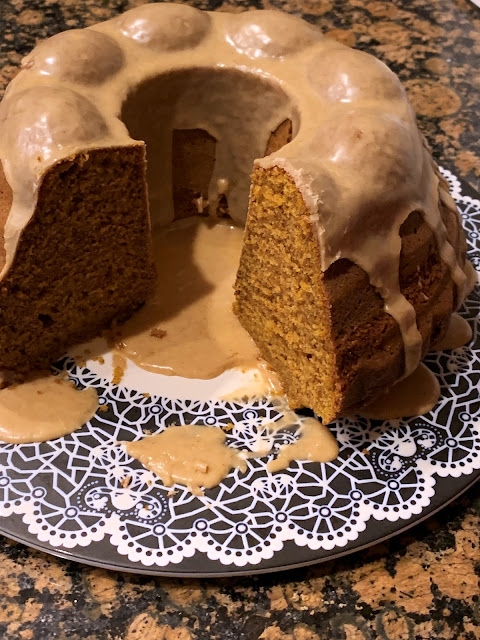
Delightful Bundt Cake with Bourbon Spiked Drizzle

I started out with nothing particular in mind one day, looking at dessert recipes. I think of all desserts to make, cakes are possibly my favorite. Anything from a simple old fashioned coffeecake tosheet cake to decorated cakes and bundt or ring mold cakes. Suddenly I came upon a site with a recipe called Gingerbread Bundt Cake with Cinnamon Rum Icing. I love gingerbread - it is a kind of cake / dessert bread cross, after all. The pictures on the site are just lovely. The mold used for the Bundt cake was exceptionally pretty, though I don't own that particular style. And I thought about it a while and wondered, "The recipe calls for applesauce. I wonder how pumpkin would do in the recipe, instead?

Bundt cake, pumpkin, gingerbread, dessert
Pumpkin Gingerbread Bundt Cake with Bourbon Spice Glaze
As I continued to peruse the recipe, I noticed that it is made a bit differently than any other cake recipe I've ever made. It called for melting butter, setting side to cool slightly, then beating together the sugar and eggs till fluffy and light. What? And then adding in the melted, cooled butter. Okay, so I went ahead with all this and made the cake with my own variations. I made the icing with Bourbon rather than rum as I have become interested in Bourbon of late.

The outcome was the finest grained cake, the most tender, and just flat-out delicious, that I had to share. The link above to the original recipe will show how it was. I loved the mix of Pumpkin and Gingerbread flavors. The drizzle icing was amazing. And here is the recipe, as I made it:


Pumpkin Gingerbread Bundt Cake with Bourbon Spice Glaze


Makes one bundt cake

200 grams unsalted butter, melted and cooled slightly
4 large eggs
360 grams sugar (about 1⅔ cup)
-----
360 grams all-purpose flour (about 2½ cups)
1½ teaspoons baking soda
¼ teaspoon flaky salt
1 tablespoon cinnamon
1 tablespoon ginger
1½ teaspoon cloves
-----
1 cup sour cream
1 cup canned pumpkin (not pumpkin pie filling)

Preheat oven to 350 degrees. Brush a Bundt pan with soft (not melted) butter and dredge with flour. Tap to release excess flour, then set pan aside.

Over low heat, melt the unsalted butter; once melted set aside. In a mixer, beat together the eggs with the sugar until they are light and fluffy, then slowly stir in the slightly cooled butter.

Separately, measure out all the dry ingredients and stir to evenly distribute ingredients. In a measure, stir together the sour cream and pumpkin to combine.

To the egg mixture add about a third of the dry ingredients, mixing on low speed to combine. Add half the pumpkin mixture and mix, then another third dry mixture, the remaining half pumpkin mixture, then the remaining dry ingredients, stirring after each addition. Pour into the prepared Bundt pan, rapping sharply on a hard surface to release bubbles.  

Bake the cake for 50 to 55 minutes, or until a tester inserted in the center comes out clean. Rest on a wire rack to cool for 10 minutes in the pan, turn out onto the rack to cool completely before glazing.

BOURBON SPICE GLAZE:
180 grams / 1¼ cup confectioner's sugar
1 - 2 tablespoons Bourbon
1 - 2 tablespoons milk or water
¼ teaspoon cinnamon
1 teaspoon fresh orange zest

Stir all ingredients until smooth. Pour over completely cooled cake.


My passion is teaching people how to create a harmony of flavors with their cooking, and passing along my love and joy of food, both simple or exotic, plain or fancy. I continue my journey in ethnic and domestic cuisines, trying new things weekly. I would love to hear from you, to help me continue my journey to explore diverse culinary experiences and hopefully to start you on a journey of your own. Join me also at A Harmony of Flavors on Facebook, and Pinterest.

Monday, January 21, 2019

On a South Indian Theme with Fish

I don't make a lot of fish. Mainly because my husband is not overly fond of it, and it requires some careful thought on how to make it the least objectionable. While I love a nice baked fish filet, placing a white block of baked fish on a plate for my husband will just not fly! I have found that making a really flavorful Indian curry sauce and cooking a very white (meaning least fishy flavored) fish in this sauce, makes a most acceptable meal for my husband. For me? Absolutely delightful!

South Indian, Fish Curry,r Meen Kuzhambu
South Indian Fish Curry or Meen Kuzhambu (with S.E. Indian Green Mango Chutney)

I have been exploring food differences in south India, after years of being stuck in the north, the "Mughlai" style of cooking that most restaurants have showcased. I love that food, those flavors. Do not misunderstand. But as I have this fascination with spices, I discover new ones and need to see how they are used. This has led me, in the last 6 or 8 months, to look more closely at southern India and the flavors that are used there. Outside of knowing that foods are highly spiced with chilis, that Panch Phoron is a common mixture to use from Mumbai on down, and that seafood and coconut are much used - there ended my knowledge of the entire rest of that country.

Part of the reason I became interested in knowing more about southern India was because I read Padma Lakshmi's memoir, "Love, Loss, and What We Ate." Padma is from Tamil Nadu, down at the southeastern tip of India. That's about as far from the Mughlai north as possible in India, and as she reminisced about the foods she grew up with and things she has made, some of these recipes and foods and techniques were absolutely unknown to me. And therefore, most intriguing!
South India, Fish Curry, Meen Kuzhambu
South Indian Fish Curry or Meen Kuzhambu

After reading about her mango chutney or "pickle," that she called Kanchanomer Tok, I found the differences from the British style of mango chutney quite interesting. I played with the recipe just a little. For starters, it is hard to find sufficiently green mangoes up in the frigid north (or for that matter, the hot sun needed to "cook" the "pickle" in the sun!), so I use ones as green as I can find, but not totally authentic. Still, what I ended up with as my recipe for South Indian Green Mango Chutney is one I have made repeatedly, as I just love the flavor combo.  

After this long-winded wind up, what I am getting to is that while I researched the spices for the last 4 blog posts on spices, I also was running across recipes that sounded interesting. Southern Indian recipes. As it happened, last evening I wanted to make some white fish. I had a couple of halibut filets. I looked at a lot of southern Indian fish curry recipes. And then took them and made my own spin. The biggest change I made was the addition of extra vegetables pureed into the sauce. This is because I continue to incorporate extra vegetables into my husband's diet anywhere I can get away with it. Particularly things like cauliflower, which is easily hidden or disguised and the flavor is not noticeable, among the abundant mix of spices and flavors.

A fish curry in southern India, as I found in quite a few blogs, is called Meen (fish) Kuzhambu (curry). 

So, finally, what I came up with turned out truly wonderful, and completely acceptable for my husband, but because of the addition of the extra vegetables, I had far more sauce than needed for two fish filets. I believe it would be best to use 4 servings of fish in the recipe, and then the sauce would be the perfect amount.

South Indian Fish Curry, or Meen Kuzhambu


Serves 4
South India, Fish Curry, Meen Kuzhambu
South Indian Fish Curry or Meen Kuzhambu


FISH MARINADE:
4 white fish filet portions (I used halibut) 
1 tablespoon coconut milk powder, optional
½ teaspoon turmeric powder
½ teaspoon salt
a squeeze of lime juice

SAUCE:
1 tablespoon cooking oil
1 teaspoon fennel seed
1 medium onion, chopped 
1 cup finely grated cauliflower
½ red bell pepper, chopped
1 green chili pepper, chopped (remove seeds for less heat)
1 - 2 cloves garlic, minced
1 tablespoon fresh ginger, minced
¼ cup dried, grated, unsweetened coconut
1 (15 ounce) can petite diced tomatoes

TEMPERING:
1 tablespoon cooking oil
½ teaspoon brown mustard seeds
10 to 12 fresh curry leaves
12 - 3 tablespoons sliced shallot
½ teaspoon asafoetida

OTHER FLAVORS:
3 tablespoons tamarind puree (or 2 teaspoons tamarind in paste-like concentrated form)
1 teaspoon crushed coriander seeds
1 teaspoon Garam Masala
½ teaspoon black cumin
½ teaspoon ground fenugreek seed

Mix together the coconut milk powder, turmeric and salt and sprinkle over the fish filets, then squeeze on the lime juice. Turn to coat the filets evenly and set aside while preparing the curry.

For the sauce, heat the oil in a large skillet and add the fennel seeds, tossing until very aromatic. Add in the onion, cauliflower and red bell pepper and saute until the vegetables are soft and the onion and cauliflower are golden and beginning to brown a little. Add in the green chili pepper, garlic and ginger and cook for an extra 3 to 5 minutes or until very fragrant. Stir in the dried coconut and the can of tomatoes (can use 2 cups of fresh tomatoes). Heat together, then pour this mixture into a blender or food processor and puree to a fine sauce. Set aside.

For the "Tempering," wipe out the skillet and heat the tablespoon of oil. Add in the mustard seeds until they begin popping, then add in the curry leaves, shallot and asafoetida and saute until the shallot is softened. Add in the pureed sauce, along with the other flavors: tamarind, coriander seeds, Garam Masala, black cumin and ground fenugreek seed. Stir well to disperse all ingredients evenly, then nestle the fish filets into this curry sauce. spooning sauce over top of the filets. Cook the filets until they flake easily with a fork, turning once during cooking. The cooking time will vary, depending on type of fish and thickness of filet. The halibut filets cooked in about 15 minutes.


My passion is teaching people how to create a harmony of flavors with their cooking, and passing along my love and joy of food, both simple or exotic, plain or fancy. I continue my journey in ethnic and domestic cuisines, continuing my journey to explore diverse culinary experiences and hopefully to start you on a journey of your own. Join me also at A Harmony of Flavors on Facebook, and Pinterest.

Saturday, January 19, 2019

My Indian Spice Drawer Part 4

Over the course of the last few days, I have showcased a lot of my spices, focusing in particular on those that I use in Indian cooking. Some are ones that are often mistaken for another, such as "caraway" (which is not used in Indian cooking at all, but much used in Europe and northern Africa) when what is really called for is Black Cumin, and poor Black Cumin gets called so many other things (like Nigella / Onion Seed / Kalonji), that it is nearly impossible to untangle without some sort of guideline to follow. In an effort to help with some of these many mistaken identities, and some just to introduce a spice you may not yet know, I have worked on these pages for clarification. 

I am not Indian. I have no particular Indian friends to help me out with this. I have, however, been cooking Indian foods for over 20 years now, and have run into a lot of unfamiliar words for things. I have spent countless hours poring over books and websites, trying to do this very same thing, and I feel at this point that I am fairly informed on the subject. 

But still. I have not been to the source. I have no one to correct me. I am going on my own hard work and effort over all these years, learning. Always learning. And as I love spices, I will likely learn of more, as time goes by. Meanwhile, I hope these pages will help someone out there.

Black Salt, kala namak, sulphur
Black Salt

Black Salt


A type of rock salt, salty and pungent, it is found mostly in the Himalayas. Black salt is comprised of several other components that give the salt its color (pink to purple) and smell (sulphur content). Though this salt can be produced from natural salts with the correct chemical compounds, it is commonly manufactured synthetically by adding ingredients and heating in a furnace. It is commonly used in Bangladesh, Nepal, India and Pakistan as a condiment added to things like chaats, chaat masalas, chutneys, raitas, salads and other Indian snacks. 

Some Indian names for Black Salt you may encounter: Kala Namak, Bire Noon, Kala Noon

~~~~~~~~~~~~~~~~~~~~~~~~~~~

Black Sesame Seed, sesame, whole seeds, spice,
Black Sesame Seed

Black Sesame Seed


(Sesamum Indicum ‘nigrum’)

Sesame seeds are all from the same plant, regardless of their color. Most commonly seen are white sesame, often on top of buns, but Black Sesame seeds have appeared more commonly over the years. In Indian cooking, they are cited specifically in an Assam sweet called “Til Pitha,” a thin cake with a black sesame and jaggery filling rolled inside. Some say that black sesame and white are the same except that the white have had the hull removed. Not entirely true. Possibly a polished black sesame seed would be white if its hull is removed, but white sesame seeds with their hull left on are a matte ivory beige in color (see below).

Some Indian names for Black Sesame Seed you may encounter:Til

~~~~~~~~~~~~~~~~~~~~~~~~~~~

White Sesame Seed, whole seed, unhulled seed, spice
White Sesame Seed

White Sesame Seed


(Shown unhulled, not polished)

(Sesamum indicum 'alba')

Sesame, sometimes known as Benne, may have originated in Africa. Many wild relatives are found in Africa and India. Sesame has one of the highest oil contents of any seed. Sesame oil (called “gingelly” oil in India) is used in many recipes, for "tempering" (adding spices and other flavors last minute to a dish that alone is relatively bland, like lentils) and general cooking. To date, I have not seen many sesame seeds of either black or white variety used in Indian recipes, except for sweets of various kinds, used like a peanut brittle. Sesame seeds appear to be used more in southern Indian foods.

Some Indian names for White Sesame Seed you may encounter:Til

~~~~~~~~~~~~~~~~~~~~~~~~~~~~

Star Anise, whole spice,
Star Anise

Star Anise, Chinese Star Anise


(Illicum verum)

Star Anise is the dried fruit of an evergreen tree indigenous to south eastern China. Produced almost entirely in China and Vietnam, there is small production in Arunachal Pradesh, in India. Generally considered an “exotic,” Star Anise can be used as an ingredient in Garam Masala and to flavor rice and meats. It is most often added whole to a dish and discarded before serving. It is often added to spiced masala chai mixtures and to most biryani dishes and slow cooked curries, potato dishes and garbanzo dishes. 


Some Indian names for Star Anise you may encounter: Badian, Badyani, Anasphal, Chakri Phool, Chakri Phul, Badal Phul

~~~~~~~~~~~~~~~~~~~~~~~~~~~

Black Stone Flower Lichen, dagad phool, tree lichen
Black Stone Flower Lichen

Stone Flower, Black Stone Flower 


(Parmotrema perlatum)

Typically used as a spice in Chettinad and West Indian (Maharashtrian) cuisines, Stone Flower, a type of lichen, has little flavor on its own and must be cooked in a little oil to release its flavor. The flavor is described as “strongly woody and with a cinnamon-like aroma and flavor.” It is typically used in meat dishes, some vegetable or lentil dishes (like my Punjabi Chole). Try it in Butter Chicken or Chicken Tikka.

Some Indian names for Stone Flower you may encounter: Dagad Phool, Kalpasi, Bojhwar, Raathi Pootha, Patthar ka Phool 

~~~~~~~~~~~~~~~~~~~~~~~~~~~~


Tamarind, pods, tree fruit, souring agent
Tamarind

Tamarind 


(Tamarindus indica)

A tree in the family Fabaceae, Tamarind is indigenous to tropical Africa, but has been cultivated for so long on the Indian subcontinent that it is considered by some to be indigenous there. The dried brown fruit pod contains dense, sticky, edible pulp surrounding black, shiny seeds which must be removed before use. The outer shell cracks off easily. The sticky fruit can be soaked for easier use. Tamarind is used most often in southern Indian cuisine and is considered a souring agent, like Mango Powder and dried Pomegranate Seeds (instead of using lemons or limes). Used most often in the southern parts of India, find it in many sauces for curries, vindaloo, sambar, lentils and dals, chutneys.

Some Indian names for Tamarind you may encounter: Imli, Amli

~~~~~~~~~~~~~~~~~~~~~~~~~


Turmeric Rhizome, fresh turmeric, powdered turmeric
Turmeric Rhizome

Turmeric 


(Curcuma longa)

More often seen in its bright yellow powdered form in the U.S., the vivid yellow orange rhizome (ginger family, Zingiberaceae) of this native of the Indian subcontinent and southeast Asia is known in many Asian cuisines, imparting strong yellow color and its warm, pungent, bitter, pepper-mustard-like flavor to savory dishes, though it lends color to widespread other products. In Indian cuisines, it is a usual component of curry powders, and commonly added to curries, masalas, pickles, dals, lentils, vegetables and many other foods to amp up color and flavors.

Some Indian names for Turmeric you may encounter: Haldi, Haldee, Huldi


My passion is teaching people how to create a harmony of flavors with their cooking, and passing along my love and joy of food, both simple or exotic, plain or fancy. I continue my journey in ethnic and domestic cuisines, continuing my journey to explore diverse culinary experiences and hopefully to start you on a journey of your own. Join me also at A Harmony of Flavors on Facebook, and Pinterest.

Disqus