Translate

Tuesday, April 21, 2015

Maraschino Cherry Cake Revision a Success

I know, cake/frosting/filling recipes two days in a row! There are lots of birthdays in April around here between friends and my family!
Maraschino Cherry Cake, revised, Moist and perfect!


I have been wanting to see if I could make a better version of the Maraschino Cherry Cake I made last August for my husband into something actually moist enough to be edible. I tried one of the tips I found online (using a vanilla pudding mix) in a white cake recipe, but I was less than pleased. While the cake may or may not have been more moist, the flavor was all wrong. Okay, so scratch that particular tip. But the real reason I looked for tips on making a cake more moist was for that Maraschino Cherry Cake. The original cake I made was tasty. Nothing wrong with flavors. It was just way-the-heck too dry. Still, when a friend of ours, Tetiana, stopped over and I offered her a piece, with the caveat that it was far too dry. I had not realized at the time that she also was a cherry fiend along the lines of my husband. For her (she said) the cake was perfect and she loved it!

Maraschino, Cherry, Cake
Tetiana's Maraschino Cherry Cake
Some of the other tips on making a moister cake were things like adding more sugar than the cake called for, adding more butter, adding some oil to the recipe, folding in either yogurt or sour cream at the end, and other things such as substituting brown sugar and using more egg yolks. These last two were not ones I would use in my Maraschino Cherry Cake, because I was basically using a white cake recipe and adding in Maraschino cherries and some of the syrup. I took the recipe I had originally created and looked through the ingredients to see where I could use some of these suggestions. 

The changes I made were minimal. Instead of milk I used an equal amount of heavy cream. I added an extra 4 tablespoons of butter and an extra half-cup of sugar, lowered the baking powder amount by a teaspoon and the salt by 1/4 teaspoon. And lastly, 3/4 cup of sour cream was folded in at the end with the cherries. Looking at these changes, I was worried about the extra butter and sugar making it too thin a batter, so I added one more egg white for binding power. I had forgotten I had some Washington cherry flavor I had gotten at the King Arthur Flour website (and appears to no longer be available). While it is not Maraschino cherry flavor, I figured it would still bring more cherry flavor to the cake, so I added a little dash of that too.

The outcome was absolutely spectacular. I made a smaller cake (two 7-inch layers instead the regular 8 or 9-inch) for Tetiana and then made one tiny 6-inch layer so my husband and I could taste and critique the cake. I divided the 7-inch layers in half, making 4 thin layers. I cut the little 6-inch layer in half also, making it a 2-layer bitty cake for us to try.The cake itself was moist as can be with fantastic cherry flavor and color. The crumb was delicate and fine. It was all I could hope for in a cake.

Maraschino Cherry Cake
Maraschino, Cherry, Cake
Tiny 7-inch Maraschino Cherry Cake


Makes one (2-layer) 8 or 9-inch round cake

6 large egg whites
½ cup heavy whipping cream
¼ cup Maraschino cherry syrup
1 teaspoon vanilla extract
½ teaspoon Washington Cherry Flavor, optional
2 sticks / 1 cup unsalted butter, softened
3 cups cake flour
2 cups granulated sugar
1 tablespoon baking powder
½ teaspoon salt
1 (10-oz) jar Maraschino cherries, drained
¾ cup / 6-ounces sour cream

Preheat oven to 350 degrees (325 on Convection Bake). Spray two round cake pans with nonstick spray. Cut parchment rounds to fit the bottom of the pans and set them in place, then spray the parchment. Set the pans aside.

Drain the jar of cherries (keeping the syrup for flavor) and cut the cherries in half or quarters. Set them aside to drain well while making the cake batter.

Whisk the egg whites together in a bowl until just foamy and well broken down. Add in the cream, cherry syrup and extract(s) and whisk well. Measure out 1/2 cup of this mixture and set aside.

In the bowl of a mixer, whisk together the cake flour, sugar, baking powder and salt. Add in the soft butter (not melted) with the 1/2 cup of liquid mixture. Begin beating slowly, increasing speed as the mixture begins to coalesce. Add in the remaining liquid mixture and beat slowly to combine, then increase speed to medium for about 1 minute to combine and aerate. On low speed, add in the drained cherries and the sour cream. Divide the batter evenly between the prepared pans, spreading evenly. Bake the cake layers for 25 to 30 minutes, or until a toothpick inserted in the center comes out with only a crumb or two. Do not over bake! The batter is very light and fluffy soft, so watch carefully.

Cool the cakes in the pans for about 10 minutes. Remove from pans and cool completely before filling and frosting.

MAKE AHEAD: If not using the cakes right away they may be frozen. The 8 or 9-inch cake pan with the cake in it can be placed inside a gallon zip-top bag and frozen for up to 2 weeks. Thaw before filling or frosting. To make the 4 layer cake, slice each layer in half horizontally to make 4 thinner layers.


~~~~~~~~~~~~~~~~

In yesterday's blog I gave the recipe for the Blackberry Mascarpone Filling  I made for the birthday cake I made for friend Heidi and myself.  I wanted to do a similar thing with the Maraschino cherry cake's filling, so I used the same recipe, using a cherry jam (again, not Maraschino cherry flavor, and I had to pass it through a sieve to make it smooth enough). To make the cherry flavor more intense, I boiled down 6 tablespoons cherry preserves with about ¼ cup of the Maraschino syrup to make a total of about the same ¼ cup of cherry as there was blackberry jam in that recipe. It worked very well and the cherry flavor was beautiful.

Cherry Mascarpone Filling


Makes enough to fill a 4 layer cake with plenty left over

1 jar (10 ounce) maraschino cherries, drained, syrup reserved
6 tablespoons cherry preserves (not jelly)
¼ cup reserved Maraschino syrup
2 sticks unsalted butter, softened
4 cups confectioners' sugar, sifted
1 teaspoon vanilla extract
½ teaspoon cherry flavor, optional
1 carton (8-ounces) Mascarpone cheese

Drain the Maraschino cherries well and cut them in half. Set them on paper toweling to drain while making the filling.

Pass the cherry preserves through a sieve. Measure the amount after sieving. In a small saucepan, combine the measured preserves and the Maraschino cherry syrup and bring to boil. Keep at a steady low boil for about 10 minutes, reducing the mixture to about ¼ cup. Allow to cool while beating the butter.
Cherry Syrup, Finished Filling
Left: the cherry mixture cooked down to thick syrup. Right, the finished Cherry Mascarpone Filling


Make sure the butter is soft. If room temperature still has the butter too hard, hold it in warm hands or use the microwave in short 2 - 5 second bursts to soften, but not melt. One or two short microwave bursts should be enough. Place the softened butter into the bowl of a stand mixer on medium speed or higher and beat it for 8 minutes, until very, very light and creamy-pale, stopping to scrape sides of the bowl once or twice during the 8 minutes. Add in the cooled cherry mixture and beat to combine. Add in the confectioners' sugar all at once and mix on very lowest setting until it is moistened. Add the flavorings to combine, then increase the speed to medium or medium high and beat until very light and fluffy, about 5 or 6 minutes more. Add the softened Mascarpone cheese and beat just to combine.


To fill the cake, spread a good layer of this filling onto a cake layer, setting some of the drained cherry halves onto the filling. Top with another cake layer and repeat, then once more, pressing gently on each cake layer as it is added. If any filling oozes out, use the tip of a butter knife or table knife to scrape away any excess. Refrigerate the cake before frosting to set up the filling so the layers do not slide around.. 

Use this filling between the layers of the Maraschino Cherry Cake for those Maraschino cherry lovers in your life!  And of course, we need Cream Cheese Frosting for this wonderful cake!

Cream Cheese Frosting


Makes enough to frost one 8-inch cake

2 sticks unsalted butter, very soft, at room temperature
4 ounces cream cheese, at room temperature
4 cups / 1 pound sifted confectioners' sugar
½ teaspoon salt
1 tablespoon heavy cream
2 teaspoons vanilla extract

Place the butter and cream cheese into the bowl of a heavy duty stand mixer and beat these ingredients for 8 minutes on medium speed, until almost white and very creamy. If the butter and cream cheese are not soft enough, the mixture will not achieve this creamy state.

While the butter is beating, sift the confectioners' sugar with the salt. Once the 8 minutes have elapsed, turn the machine off. Add the confectioners' sugar mixture all at once and begin to mix on very low speed for about a minute, until moistened. Increase speed and add in the vanilla and heavy cream. Beat for at least 6 minutes more. The frosting will have increased in volume and will be very light and fluffy. The texture will be very soft, but hold stiff peaks and any designs piped on.

NOTE: For added vanilla flavor, scrape the beans from ½ of a vanilla bean and add to the mixer bowl when adding in the confectioners' sugar.


My passion is teaching people how to create a harmony of flavors with their cooking, and passing along my love and joy of food, both simple or exotic, plain or fancy. I continue my journey in ethnic and domestic cuisines, continuing my journey to explore diverse culinary experiences and hopefully to start you on a journey of your own. Join me also at A Harmony of Flavors on Facebook, and Pinterest.

Monday, April 20, 2015

Yummy Blackberry Mascarpone Filling for Cake

My birthday was just a few days ago, though we celebrated it the week before, with our guests. One of the guests, Heidi, had her birthday just a few days before mine, so we celebrated together. Luckily, we both love white cake with white icing, so that part was a no-brainer. I did play with the white cake recipe just a bit, to see if I could get it to be more moist. For me, the recipe is delicious as is. I found it someplace on the web but I am not sure exactly where. Wherever I found the recipe I use, it is quite wonderful, but you know, I just have to tinker. Tweak. Nudge. 
White Cake, Blackberry, Mascarpone, Filling
White Cake with Blackberry Mascarpone Filling


The reason I tinkered with this recipe at all is because last year for my husband's birthday I made a Maraschino Cherry Cake. He is a total Maraschino cherry fiend, so I thought this cake would be a treat. I had used this white cake recipe as the basis, and added in a 10-ounce jar of cherries with some of the juice. The cake looked lovely. It tasted great. Unfortunately it was just so dry it was very hard to enjoy. Looking ahead to trying this Maraschino cake again, I'd been planning to do some research on how to make that cake (and any cake) more moist. There just happened to be a site out there with a lot of tips, some of which I decided to try. Off the top of my head, some of the tips were:
  • if possible, use brown sugar instead of white sugar
  • if possible, use whole eggs, or add more yolks
  • mix a dry instant pudding mix with the dry ingredients for the cake
  • add one (8-oz) carton of yogurt or sour cream to the batter
  • use more sugar than called for
  • add more butter or some oil
There were more tips (go here for that most informative site), but these were ones I recall. For the white cake I was going to make for our birthdays, I would not be adding whole eggs or yolks, and even less use brown sugar. I did decide to try adding one vanilla pudding mix with the dry ingredients, but I will probably not use that particular tip again. I could taste the artificial flavors of the pudding. It was still really good cake, and possibly more moist, but at least for the white cake recipe itself, I will be leaving well-enough alone.

So, although I was making white cake and white icing for our birthday cake, I did decide to make a filling that was different. I know Heidi loves fruit pies, particularly berries. I have made a fruit pie for her once, but this time I wanted to try something new. I wanted to use blackberries, to make the filling berry flavored and colored, and I wanted to use Mascarpone for some tang and to cut the sweetness. My first dilemma was to figure out how to make the filling taste of berries without adding too much liquid. The last thing I wanted was for the layers to squash the filling out, making the cake look like it had a few spare tires.

White Cake, Blackberry, Mascarpone, Filling, blackberries
White Cake with Blackberry Mascarpone Filling and fresh blackberries

Finally I came up with an idea. I would use some seedless blackberry jam. I chose Polaner's only because it had no added sugar, per se (I know it has sugars, but it is not as sweet as some). If you use a jam with seeds or bits of fruit, press it through a strainer first. I do not suggest using jelly as it is too difficult to get it to meld into the icing. I used a version of my standard icing recipe and just added in some of the blackberry jam. It was too pale (I felt) so I added a little red food coloring. Unfortunately, this removed any trace of the pretty pale purple and turned it solid pink. Oh well. I do have some blackberry flavor extract, so I added in a tiny bit of that, as well as 1 tablespoon of Chambord liqueur. Chambord is raspberry flavored, but I just wanted to up the berry flavors as much as possible. I didn't add the Mascarpone until the icing was finished, and then only mixed until it was just all incorporated. This filling was absolutely stellar!

I had sliced the two layers of the cake in half, making 4 layers. The filling went onto the first half, and then I sliced fresh blackberries lengthwise and set them onto the filling. I did the same on the next two layers. Then I went ahead and made the white icing and frosted and decorated the cake with that. This filling did separate a little, looking slightly curdled, but I was not intending it for the outside of the cake anyway. As a filling, the flavors were just fabulous. Except for the artificial flavor component in the cake itself, this cake was (to me) just to-die-for. Here is the filling recipe as I made it:

Blackberry Mascarpone Buttercream Filling


Makes enough to fill an 8 or 9-inch cake, layers cut in half (three inner layers)

2 sticks unsalted butter, softened
White Cake, Blackberry, Mascarpone, Filling, blackberries
White Cake with Blackberry
Mascarpone Filling and fresh blackberries

4 cups confectioners' sugar, sifted
4 tablespoons (1/4 cup) seedless blackberry preserves (not jelly)
1 teaspoon vanilla extract
½ teaspoon blackberry flavor
1 tablespoon Chambord liqueur, optional
1 carton (8-ounces) Mascarpone cheese, softened
1 small carton fresh blackberries, sliced in half lengthwise

Make sure the butter is soft. If room temperature still has the butter too hard, hold it in warm hands or use the microwave in short 2 - 5 second bursts to soften, but not melt. One or two short microwave bursts should be enough. Place the softened butter into the bowl of a stand mixer on medium speed or higher and beat it for 8 minutes, until very, very light and creamy-pale, stopping to scrape sides of the bowl once or twice during the 8 minutes. Add in the blackberry preserves and beat to combine. Add in the confectioners' sugar all at once and mix on very lowest setting until it is moistened. Add the flavorings to combine, then increase the speed to medium or medium high and beat until very light and fluffy, about 5 or 6 minutes more. Add the softened Mascarpone cheese and beat until just combined.
Filling, cake layers
Filling the cake layers

Spread the filling onto the first cake layer, evenly. Set blackberries, cut side down onto the filling. Top with the next cake layer and repeat. Do this once more, then top with the remaining cake layer and frost the cake as desired. 


My passion is teaching people how to create a harmony of flavors with their cooking, and passing along my love and joy of food, both simple or exotic, plain or fancy. I continue my journey in ethnic and domestic cuisines, continuing my journey to explore diverse culinary experiences and hopefully to start you on a journey of your own. Join me also at A Harmony of Flavors on Facebook, and Pinterest.

Sunday, April 19, 2015

Delicious Fish Stew

Okay, I know many might read this title and think, "What in the world could possibly make a fish stew delicious?" My husband is one of these. And then there are more adventurous people who might just be intrigued. The dish in question is one I learned to make while living in Guatemala, and it was made exclusively for Good Friday. I made this stew every year for Good Friday, once I learned to make it, and I truly looked forward to making it, because I really loved it. Originally, the recipe is called Bacalao a la Vizcaina, or Cod in the style of Biscay (as in Biscay, Spain). In Guatemala, the dish was traditionally made with salt cod. Learning to use salt cod was interesting. Granted I was in my early 20s at the time, and had never heard of salt cod before. 

Bacalao, salt cod, Vizcaya, Biscay, Spain
Bacalao a la Vizcaina

Variations on a Dish from Spain

As with any dish, who makes it will determine how it is made. Even in a small area, each cook will have their own spin put on the "way it should be done." To have a dish from northern Spain, made in Guatemala, one can imagine how far some of the changes might go. And yet, there are still some basic ingredients that stay the same. Salt cod of course, is the basis of this dish, whether in Spain or Guatemala. The use of olive oil, onions and tomatoes to make the sauce is held in common, though even in Spain there is question as to whether the sauce should be made with only red bell peppers rather than tomatoes. In my recipe from Guatemala they added both, and I have noted in looking around the internet that most recipes use both. Some recipes call for potatoes. Some call for olives. Some for garbanzo beans. Still other recipes call for other vegetables such as peas or carrots. The recipe from my ex-in-laws in Guatemala uses potatoes, carrots, capers and even pickled cocktail onions! 
Not endorsing these brands; just using what was on hand!

The Spanish, apparently, use this dish for Christmas and Easter holidays where it often has chorizo sausage added in. This would exclude the dish from strict Catholic Good Friday meals. In my opinion, the dish is certainly a holiday-type fare, with all the little additions I mentioned at the end of the last paragraph, and the fact that it is so very delicious.

On Using Salt Cod

If you have never used salt cod, it is cod that has been dried and salted heavily to preserve. To use salt cod, it must first be soaked in clear water for 2 or 3 days, changing the water daily, to both plump the fish back to its mostly original size and weight, and more importantly to remove the heavy amount of salt, which would make it completely unpalatable otherwise. The salt cod I bought when in Guatemala was sold in a wooden box. It came from Spain or Norway, usually. The fish was rather strongly scented and quite hard. It is set into a casserole or other dish with a lid, covered in water, lid placed on and refrigerated. The next day, it would be removed from the fridge, drained, again covered in clear water, lidded and refrigerated. Next day, this step is repeated, and only on the fourth day was it ready to use in a dish. To make the Bacalao a la Vizcaina for Good Friday, I would start soaking the cod on Tuesday in order to be ready to make the stew on Friday. Even after all this soaking, one never, ever had to add salt to the dish, as there was always a significant amount of residual salt in the fish; enough so to salt the dish perfectly.

My Latest Experience

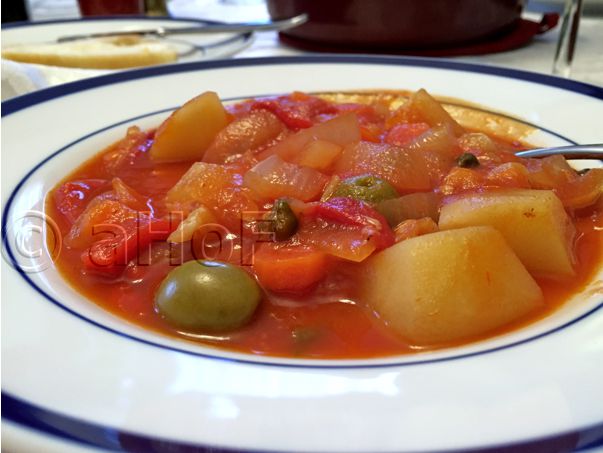
My Bacalao a la Vizcaina, in the pot
Trying to find salt cod here in the US these days is a far more difficult task. I looked online for hours and was nearly ready to give up altogether. Most places that sold it had prohibitive prices. As if that were not enough, most places had absolutely scathing reviews on the fish. I finally ordered some through Amazon, though it was described as "12 ounces, which would plump up to 1 pound". The boxes I used to get in years prior were a pound of dried fish - VERY dried fish. I am pretty sure, though I never weighed it, that this would plump to something more like 1½-pounds. The "salt cod" that actually arrived on my doorstep this year was already quite wet and slightly plump, though covered in salt. I proceeded to make my Bacalao a la Vizcaina as I always did, soaking the cod for three days, changing water daily. Then, when ready to make the dish, I made the "stew" part, cooking until the vegetables were tender. I cooked the drained fish, covered with another change of fresh water until it could be flaked. After flaking, it was added to the stew just before eating.

I will say, this fish, once reconstituted fully and cooked, seemed to be quite nice. However, my initial misgivings on seeing already partly plumped salt cod were well-founded. This cod was certainly not that fully dried-and-salted sort I'd had in past. As a matter of fact, the stew ended up needing salt added, which in many, many years of making this dish, had never been the case. 

My reasoning, then, is that:
  • If salt cod is nearly impossible to find here,
  • If it is not nearly as "salted" as the salt cod I'd had in past,
  • If I have to add salt to the dish anyway,
  • Then why not just use some nice fresh cod and add salt as I normally would in a dish?

A "Stretchy" Recipe

If you should choose to make this dish, please understand that (at least in Guatemala) this was one of those stews that could be stretched to fit the need. Less vegetables and water were added if the dish was to serve a small family. Lots more potatoes and carrots were added, with more water, if it was to serve a larger crowd. I suggest, if using fresh cod instead of salt cod, to use at least a good 1½ pounds as the least amount. You might add more, if needed, for a larger crowd. The recipe is simplicity itself. Not overcooking the fish is the only thing to be careful of, as overcooked fish is rubbery, at best. The "stew" part of the recipe is the time it takes to cook the vegetables through, no more. The fish is added at the last minute. All that said, I love the reheated leftovers just as much!


Bacalao a la Vizcaina

Bacalao, salt cod, Vizcaya, Biscay, Spain
Bacalao a la Vizcaina

Serves 6 - 10, depending on how one makes the dish

1 pound salt cod, reconstituted, OR
1½ pounds fresh cod (in which case add salt to the stew)
2 - 4 tablespoons olive oil
2 - 3 white or yellow onions
2 - 6 cloves fresh garlic, minced
2 - 3 cans (6 ounce each) tomato paste
4 - 6 cups water
2 - 4 jars (4 ounces each) sliced pimiento, with their liquid
1 small jar green olives (about 15 - 20 olives, drained)
2 - 4 tablespoons small capers, drained
1 small jar cocktail onions, drained (about 15 - 20)
3 - 6 carrots, peeled, sliced in coins a scant ¼-inch thick
3 - 5 medium potatoes, peeled, cubed

If using salt cod, begin 3 days prior: remove salt cod from wrappings, rinse and set into a glass or ceramic casserole with lid. Cover with water, set lid in place and refrigerate. Next day, drain the water, add fresh, cover and refrigerate. Repeat this again next day. On the day of making the stew, Drain the water again, set the fish into a saucepan, cover with water and gently bring to a simmer, cooking until the fish will easily flake when pressed with a fork. Drain, cool slightly and flake the fish. Set aside.

To make the stew: Slice the onions in half, lengthwise and then cut across into 1/4-inch thick half-ring pieces. Heat a stew pot and add the olive oil. Cook the onions in the olive oil gently, stirring occasionally until tender and barely golden. Add the garlic and stir until fragrant. Add in the cans of tomato paste and begin adding water, mixing to make the stew base. Add in the pimiento slices with their liquid, the drained olives, capers and cocktail onions. Add the carrots and potatoes, cover and cook until the vegetables are tender, about ½ hour or 45 minutes. When ready to serve, stir in the flaked fish. Serve with crusty French bread.


My passion is teaching people how to create a harmony of flavors with their cooking, and passing along my love and joy of food, both simple or exotic, plain or fancy. I continue my journey in ethnic and domestic cuisines, continuing my journey to explore diverse culinary experiences and hopefully to start you on a journey of your own. Join me also at A Harmony of Flavors on Facebook, and Pinterest.

Friday, April 17, 2015

Lamb Burgers to Die For

Birthday, Cake, Blackberry, Mascarpone, Filling
Birthday Cake with Blackberry Mascarpone Filling 
Hello! I have had guests for the past weeks, coming and going. It's been wonderful having our friend Rich visiting, as well as his significant other, Heidi, and always a stupendous lot of fun when my son Kenneth and his wife come to visit. Because of the amount of guests, and amount of food prep and other things attendant on having guests in the house, I hadn't managed to get to a blog for about 11 days now. It is good to have the house quiet again, no matter how I love them all. So here I am, back at my blog, and a year older, too!

I just had my 65th birthday yesterday, though we celebrated with our guests last weekend. Yesterday was totally normal day with work to be done, though my friend Deb took me out to lunch, which was excellent.

Calamata, olives, Tapenade
My Calamata Tapenade
When my son and his wife visit, I try to make some favorite things. I have used a recipe for lamb burgers found on the internet quite a few years ago. This was long before I had any idea about writing a blog, maintaining a website or any such thing. This year I got out the recipe and taking a good look, realized I probably never actually used the recipe except as a guideline. For example, the original recipe calls for 2 ½ pounds of ground lamb and only 2 cloves of garlic, for starters. I love garlic, and so does almost everyone I cook for. I used 6 large cloves of garlic when making these burgers last week. And, so it went with a lot of the recipe.

The recipe called also for making a tapenade to go on the burgers and while I like tapenade (or what passes for tapenade in jars in the grocery), I had never made it myself. My husband wouldn't eat it anyway, so if it is just the two of us, I wouldn't bother. But in talking to friend Rich, along with Ken and Julia - they all love tapenade, or at least olives, so that was the one totally new and different thing I did this time. Julia made a run to the nearby grocery and brought back some marinated Calamata/Kalamata olives. If I made this tapenade again (and I most certainly will!), I would look for these same olives, because the flavor was so excellent. I had only 4 remaining ("orphan") Kalamata Olives in a jar in the fridge, so I added these to the ones Julia brought home in making the tapenade.

children, son
My son, Kenneth
I pride myself on grilling things pretty well, but I have to hand it to my son - he just has a knack. My grill racks get scraped down when I grill and all, but I have not cleaned the pan below. The lamb was quite fatty also, and all this contributed to a total conflagration. On my own, I would likely have burnt the burgers. Ken came out to tend them and managed to bring in perfectly done burgers, with perfectly soft Feta on top. I was way amazed at his grilling prowess. Yea, Kenneth!

We came to the table to eat and such was the excitement that I absolutely and completely forgot to take photos of these amazing burgers. Good grief! All I got was one photo of the two remaining burgers on the serving plate and the dregs of the remaining tapenade. Not the best or prettiest photos, for sure, though one can certainly see the perfection of the grilled burgers. While great photos are sadly lacking here, I pray that anyone who loves lamb might try these recipes out, because oh, MAN are they ever just to-die-for-good!


Grilling, Lamb, Burgers, Feta
Perfectly Grilled Lamb Burgers

Lamb Burgers with Grilled Feta and Tapenade


Makes 6 large burgers

BURGERS:
2¼ - 2½ pounds ground lamb
6 cloves garlic, finely minced, or through a garlic press
2 tablespoons fresh oregano leaves, minced
3 tablespoons fresh mint leaves, minced
¼ teaspoon cinnamon
2 teaspoons salt
½ teaspoon fresh ground black pepper
1 teaspoon Garrigue Seasoning, optional

8 ounces Feta Cheese, cut into approximately 6 slices

Mix all the burger ingredients well and form patties of approximately 1/4 pound apiece. Grill the burgers to desired doneness. Use a grill pan for the Feta, to soften. Feta does not really melt, but will warm nicely. Set one slice of Feta atop each burger. Serve with Tapenade on buns. A heftier, larger type of bun is needed for these large burgers than the cheaper types of bun available!

Calamata, kalamata, olives, tapenade  
Olives I used for Tapenade
TAPENADE: Enough for 6 burgers
7 - 8 ounces pitted Calamata/Kalamata olives, drained
2 tablespoons fresh parsley, finely minced
2 large cloves garlic, chopped
¼ cup olive oil (more, or less, as desired)

Place the olives, parsley and garlic in a food processor to finely chop. With processor running, add in olive oil until the mixture is at the consistency you prefer.

Serve the tapenade on the side, to spread onto the buns when serving.


My passion is teaching people how to create a harmony of flavors with their cooking, and passing along my love and joy of food, both simple or exotic, plain or fancy. I continue my journey in ethnic and domestic cuisines, continuing my journey to explore diverse culinary experiences and hopefully to start you on a journey of your own. Join me also at A Harmony of Flavors on Facebook, and Pinterest.

Monday, April 6, 2015

Third Time is the Charm for Lemon Meringue Pie

Lemon, Meringue, Pie, lemon curd, pastry
This year's Lemon Meringue Pie
Two years ago for Easter I was asked to bring a Lemon Meringue Pie and a Coconut Cream Pie to the Easter festivities at my sister-in-law's house. I got the cold chills thinking about attempting either of these two pies. I have made chiffon pies, fruit pies, nut pies and Chess Pie, but the last time I had tried a Lemon Meringue Pie was when I lived in Guatemala, circa 1973. It came out okay, to my recollection, but my memory could certainly be imperfect at this remove. I had never made another since then, so maybe it didn't come out as well as I recalled. I could not even think of when, if ever, I had made a coconut cream pie. My current husband, of 25 years, dislikes coconut to begin with, and is not over-fond of lemon and tart desserts. When I eat either of these pies, it is as an indulgence when dining out somewhere.

That first attempt at both those pies was a complete and utter disaster, coming out more soup like than pie. 

Then last year I was asked to make another Lemon Meringue Pie for Easter (I was surprised to have been asked, after the soup-like consistency of the previous year's attempt). This time I used Rose Levy Berenbaum's Classic Lemon Curd recipe, doubled (from "Rose's Heavenly Cakes"), and at least the lemon part of the pie was completely perfect. It cut well and held shape. The meringue, however, continued to leave a LOT to be desired. This is what I did with the Lemon Curd part of the recipe:

Lemon Curd, Blind Baking, Pie Shell
Lemon Curd in Blind Baked Pie Shell

Lemon Curd


Makes enough for a 9 or 10-inch pie

4 teaspoons lemon zest, lightly packed
10 large egg yolks (set aside 4 of the whites for the meringue later)
1½ cups sugar
1 stick unsalted butter, room temperature
6 ounces (¾ cup) fresh lemon juice
pinch of salt

Place the zest in a bowl. Place a fine mesh strainer over the bowl and set aside.

In a medium saucepan, whisk together the yolks, sugar and butter. Slowly whisk in the lemon juice until combined. Set the pan over medium low heat and begin cooking the mixture, stirring constantly with a silicone spatula or wire whisk, scraping bottom and sides regularly. You will want to keep heat low as too high a heat will cook the yolks and curdle the mixture. This is easier than it sounds. Just keep stirring and if the mixture looks like it wants to boil, remove the pan from the heat instantly, stirring or whisking briskly to keep the heat down. This process can take 15 minutes or so. It is done once the mixture turns more opaque and will coat the spatula or whisk.

Once at point, pour the mixture through the fine mesh strainer over the bowl with the lemon zest. Press the curd through the strainer. Once all through the strainer, stir the mixture gently to mix in the lemon zest. Set aside to cool for one hour, placing a piece of plastic wrap directly onto the surface of the curd, to prevent a skin forming. After cooling to room temperature, refrigerate for at least another 2 or 3 hours before using.
 

~~~~~~~~~~~~~~~~~~~~~~~~~~~~~~~
 

The Meringue Conundrum

The reason for the meringue difficulty is that Easter "dinner" is served at 12 noon. The trek out there is an hour away. To get myself and any foods ready in the morning is a stretch, so I have made the pie(s) the night before on both these occasions. Any time one makes a meringue topping it will eventually tend to shrink and pull away from the edges of the pie if it is left for a time. It is whipped air bubbles. They will burst and shrink. No real getting around that. In trying to find a way to make meringue that remains more stable, I had tried to make an Italian Meringue the first year. Obviously, I overcooked the sugar syrup and obviously, I did not keep the syrup close enough to the edge of the bowl while beating. The meringue was filled with sharp little pieces of hard sugar candy. The second meringue attempt was one that had a cornstarch pudding mixed in to stabilize. It didn't (stabilize) and the consistency was gross. No other word for what I ended up with.

When I was once again asked to make a lemon meringue pie for Easter dinner this year I figured either they are testing my stamina, or hoping for a better outcome (beginning to sound like the definition for insanity), or they are just masochists. 

Well, at least I knew I could make a good lemon curd, and that is half the battle. But the meringue was still my bugaboo. I spent some time thinking about the Italian Meringue. I did more research on the making of it, and the timing of things. I also wondered if perchance the fact that I live at just over 1,000 feet above sea level could possibly be causing a problem with cooking the sugar syrup. I couldn't find too much on that topic, but somewhere I read that it would work better if cooked to 2 degrees less than what the recipe called for. Of course, recipes vary also, and some called for the syrup to cook to 340 degrees and some said 338 degrees. Heavens...
meringue, making meringue, recipe
This year's Lemon Meringue Pie with lovely meringue

So What is Italian Meringue?

There are three main types of meringue: French, Swiss and Italian. 
  • French meringue is your most basic: beat the whites until soft peaks form, gradually beat in sugar until the mixture is glossy and holds peaks. It leaves the egg uncooked, until it is baked to brown.
  • Swiss meringue is made similarly to a 7-minute icing. Mix the egg whites with sugar in a bowl set over (not in) boiling water and beat until they form glossy peaks. This makes a more dense meringue.
  • Italian meringue requires cooking sugar and water to soft ball stage (235 to 240 degrees F). While the syrup cooks, the whites are beaten with a little cream of tartar or lemon juice, then the hot syrup is poured slowly into the meringue while beating constantly (a bit of a juggling act) to stiff glossy peaks. This method leaves the whites cooked enough to consume without further baking, if needed. This also leaves the meringue the most dense of the three.
If you, like me, dislike the regular meringue with that bubbly, burst-in the-mouth quality, then one of these other two variations could be your better bet. I love the consistency of Italian meringue, though some feel it is dense and candy-like. Your choice.

Things I Resolved to Do on the Meringue Front

In order to get the meringue to come out properly, I read, there are a few things to consider. These are ones I resolved to do:
  1. The egg whites should be fresh (as opposed to older), but at room temperature to whip to best volume.
  2. Do not wait to beat the whites until after the syrup is ready! This will likely have the syrup overcooked by the time the whites are at soft peaks.
  3. You will not want the whites beaten too much or too hard before the syrup is added. It is dangerous (unless you are well-versed in making this meringue) therefore, to use a heavy duty stand mixer, because it is far too easy to over beat.
  4. Along the same lines, the heavy duty mixer has beaters that beat very close to the edge of the bowl. Once any of the syrup hits the beaters, you've ruined the perfectly smooth meringue.
  5. Because of numbers 3 and 4 above, I opted to use my small hand mixer. It beats far more slowly and it is easier to keep the beaters away from the syrup.
  6. Lastly, I opted to split the difference and cook the syrup to 237 degrees. Not 238 and not 240.
 
meringue, lemon, curd
Pile the meringue onto the curd

Italian Meringue


Makes enough to mound high on a 10-inch pie

1⅓ cup granulated sugar
6 tablespoons water (3 ounces or 90 ml.)
4 large egg whites, room temperature
¼ teaspoon cream of tartar
1 teaspoon vanilla extract, optional

Have the room temp egg whites in a large bowl with the cream of tartar. Combine the sugar and water in a medium saucepan over medium heat and bring the mixture to a boil. Once boiling, cover the pan with a tight fitting lid for about 2 minutes, to wash down any stray sugar crystals from the sides of the pan. Remove the lid and insert a candy thermometer so that it is in the sugar mixture but not touching the bottom of the pan. Cook without stirring to between 235 and 240 degrees. If at sea level, you might cook to 240 degrees. At 1,300 feet, I cooked the syrup to 237 degrees.

While the syrup is coking, begin beating the egg whites in the bowl. Beat on medium speed, only to the point where they barely will hold a peak. Once syrup is cooked to temperature, begin pouring the syrup into the whites in a thin stream, while continuously beating with the mixer, ensuring the syrup is well incorporated, without getting syrup onto the beaters. Continue to beat the meringue until it is cooled. It will be quite hot right after incorporating the hot syrup. To speed this process, the bowl can be set over cold water to finalize the beating and cooling process. Lastly, beat in the vanilla, if using.

Preheat the oven to 375 degrees (350 on Convection Bake). Spread the meringue onto the top of the lemon curd in the blind baked pie shell, ensuring the meringue is well sealed against the pie shell. Use a spoon to artfully make lovely peaks all over the meringue. Bake the pie for 12 minutes, to brown and set the meringue.
meringue, pie, topping
Spread meringue to edges and artfully create lovely peaks

And then the Pie Shells...

Another of my bugaboos in the kitchen is blind baking pie shells. They just never seem to come out well for me. They slip down into the pie plate and end up completely uneven. I consider myself a good baker. My main bulk of baking, however, is cookies, cakes, bars, crisps, with pies a far bit behind. I make a tasty and flaky pie crust, though I dislike doing it. I (unlike many) really love the bottom soggy crust, so that is never an issue in my book! I love eating pies, including all the ones I mentioned earlier. Chess Pie is probably one of my (and my husband's) favorites. 

Lemon Meringue Pie requires a blind baked pie shell. Every time I make one, I am fearful of how it will look once baked. This time, I decided to try and take every precaution I could think of:
  • I crimped the edge of the pastry well up and to the most outer edge of the pie pan. I have always tried to do this anyway, but not often successfully.
  • I used a knife tip to very thoroughly prick steam vent-holes all over the bottom and sides of the shell, in hopes it would prevent undue puffing and/or deflating.
  • I molded a piece of foil to another like-sized pie plate bottom, so it would fit well into the unbaked shell for the first part of baking.
  • I lined the bottom and sides of the unbaked pie shell with this molded foil, and then used a full pound of dried beans in the foil as pie weights. I also made sure to push the weight of the beans mostly against the sides, so it would support the sides and prevent the sliding downwards I have encountered, to date.
Guess what? I got the best looking blind-baked pie shell I believe I have ever made! Practice makes perfect. Try, try again. All those platitudes actually work. Whew!

Unbaked pie shell, blind baking, foil liner, dried beans
Unbaked shell, lined with foil and dried beans

Single Crust Pie Shell


Makes one 9 or 10-inch pie shell

1½ cups all-purpose flour
⅓ cup lard, shortening or butter
½ teaspoon salt
3 to 5 tablespoons water

Place the flour and salt into a large bowl. Using a pastry blender or two knives, cut the lard (or shortening or butter) into the dry ingredients until it makes a nice crumbly mixture. Begin adding in the water, a tablespoon at a time, using a fork to lightly toss the water and crumb mixture. Once the mixture will come together in a ball, no more water is needed. Bring the mixture together and wrap tightly. Chill the dough for at least an hour or up to 3 days.

When ready to use, sprinkle a surface with flour and roll out the dough to about ⅛-inch thick. Roll the pastry back onto the rolling pin, then unroll it over the pie plate. Gently ease it into the plate, then trim the edges to about ½-inch wider than the pie plate. Fold this overhang under, and then crimp the edges as high onto the rim as possible.

If filling the pie shell with a filling that will need cooking, it is now ready to use in your recipe. If blind baking, preheat the oven to 400 degrees. Prick steam vent holes all over the bottom and sides of the shell. Set a piece of foil into the shell and weight the foil with pie weights or dried beans. Push the beans so they will press against the sides of the shell and prevent undue sagging. Bake the shell for about 10 to 12 minutes, then remove the beans and foil and continue baking for another 10 to 12 minutes, or until the shell is golden and crisped all over. Cool the shell. Discard the beans. (The beans "can" be used after the baking, but are not best in either flavor or "good for you").


My passion is teaching people how to create a harmony of flavors with their cooking, and passing along my love and joy of food, both simple or exotic, plain or fancy. I continue my journey in ethnic and domestic cuisines, continuing my journey to explore diverse culinary experiences and hopefully to start you on a journey of your own. Join me also at A Harmony of Flavors on Facebook, and Pinterest.
Sunday, April 5, 2015

Pancakes Fluffy and Light

First off, I don't make pancakes too often anymore, mainly just because I don't need the gratuitous carbs. I do love pancakes though, and I had been talking with our friend Rich about buckwheat and Kamut® Khorasan. I wrote quite a bit on the subject of Kamut® Khorasan in my blog of November 21, 2014, so I won't go into all that again. I will say that I love trying out new and different grains. And besides, I just love buckwheat pancakes. 

Buckwheat, Kamut® Khorasan, Pancakes
Buckwheat and Kamut® Khorasan Pancakes

A Bit about Buckwheat

Buckwheat
Buckwheat: triangular, green or tan in color
Buckwheat, Fagopyrum esculentum, is not wheat, or even related to wheat. It is not a grass either, nor is it related to rice. It is instead related to such plants as sorrel, knotweed and rhubarb. Because the seeds are eaten, it is sometimes called a pseudo-cereal. Buckwheat is a very ancient food, first domesticated and cultivated around Southeast Asia as far back as 6,000 BCE. The little "seeds", triangular in shape, are actually fruits encasing a seed. The fruits are so closely wrapped around their seed that it appears that the outer coating is just a hull. The seed coat is green or tan, and darkens the flour when the seeds are ground. Buckwheat contains no gluten, so it is considered safe for those with gluten intolerance. 

Buckwheat was once used widely, but its use tapered off with the rise of other grains, easier to grow and produce. Of late, resurgence of interest in ancient grains has led once again to buckwheat's popularity. Buckwheat is commonly made into noodles (soba), blinis, pancakes. There is also buckwheat honey. It is used as a thickening agent in soups. It can be cooked and eaten as porridge. Buckwheat hulls have been used to stuff pillows, as the hulls easily adjust to the shape of head and do not conduct heat as do many synthetic products. This is only a very brief synopsis of buckwheat history and use, but hopefully it will give some idea.

On to the Pancakes!

So as we were talking, Rich and I, he allowed that he would certainly like to have some pancakes, if only once, as he is also trying to keep his carbs on the low side. This morning seemed a good time to try out this recipe. I wanted to use the Kamut ® Khorasan instead of regular wheat flour, and I added in just a small bit of regular white cake flour to lighten up the mix. I love to use buttermilk in my pancakes, but when I don't have buttermilk in the house, I do generally have evaporated milk and vinegar or lemon juice. Mixing up a half evaporated milk / half water mixture and adding in about a tablespoon of vinegar or lemon/lime juice per cup of milk makes a very acceptable substitute for buttermilk. Since my husband bought me a Wonder Mill, I have been enjoying the ability to just instantly grind a grain or seed as needed. I ground ½ cup each of Kamut® Khorasan and buckwheat, to make the needed ¾ cup each for the recipe. I still had just a little left over, but that makes no big difference to me - I will toss that into something else as I am baking or cooking. 

Buckwheat, Kamut® Khorasan, Pancakes
Texture of Buckwheat and Kamut® Khorasan Pancakes
When I placed the Kamut® Khorasan into the Wonder Mill, I absolutely forgot to reset the dial to fine grind. As it was on coarse grind when the machine started, and it takes mere seconds to grind, the Kamut was done before I even realized. I figured, oh well, so part of the flour would be a little coarse. I turned the dial to fine grind before adding in the buckwheat. As it turned out, Rich, my husband and I all marveled at the fluffy and lovely texture of these pancakes. I am not sure of the why, but these came out tender and perfect and really, really good! For full grain pancakes, they were very light.

Buckwheat & Kamut® Khorasan Pancakes 

Buckwheat, Kamut® Khorasan, Pancakes
Buckwheat and Kamut® Khorasan Pancakes

Makes about 16 pancakes

¾ cup Kamut® Khorasan flour
¾ cup buckwheat flour
¼ cup cake flour
2 tablespoons sugar (or substitute 2 packets of Stevia sweetener)
2 teaspoons baking powder
½ teaspoon baking soda
½ teaspoon salt
2 cups buttermilk or soured milk (see above)
2 eggs
4 tablespoons melted unsalted butter

In a mixing bowl, combine the first 7 ingredients and whisk to combine. Separately, mix together the buttermilk, eggs and melted butter. Have a griddle ready at 350 degrees, or a large nonstick skillet over medium heat. Use oil, baking spray or whatever grease is preferred and begin ladling out the pancake batter. Once the edges of the batter look dried and there are many bubbles over the surface that leave holes once they burst, flip the pancakes to the other side. The second side will take far less time than the first.
Serve these pancakes as with any other pancakes, with maple syrup, honey, fruit, fruit pie filling or whatever favorite thing you like with pancakes.  


My passion is teaching people how to create a harmony of flavors with their cooking, and passing along my love and joy of food, both simple or exotic, plain or fancy. I continue my journey in ethnic and domestic cuisines, trying new things weekly. I would love to hear from you, to help me continue my journey to explore diverse culinary experiences and hopefully to start you on a journey of your own. Join me also at A Harmony of Flavors on Facebook, and Pinterest and sign up for my Newsletter.

Thursday, April 2, 2015

Dessert Bars Made With Yuca Root

yuca root, manioc, starchy tuber, dessertOnce again, I have a recipe to share that is made with an unusual ingredient. Most stores these days carry some of the more unusual vegetables, and I have been able to find Yuca in most of the places I have lived. Yuca is a tuber root vegetable, Manihot esculenta. Called by many names in different countries, it is also known as cassava or manioc root. I first learned of and tasted this root in Guatemala long ago. It is a highly starchy root, far starchier than a potato, though it is potato-like in its usage. It has little strong flavor of its own, but lends flavor and filler to soups and stews. It is great in soups, and I have used it this way often over the years. 

All that aside, when in Guatemala I also learned that they make desserts out of the most unlikely vegetables (to a mid-westerner born and raised). So it was that I learned that the Yuca root is also made into a dessert. They call it "Torta de Yuca" down there. A Torta is often a nut based cake of many tiers, or any cake made into many layers. This particular "torta" is just a bar-type dessert. It has no crust, and is not like a cake in texture or consistency. The texture of this dessert comes out more along the lines of pumpkin bars or lemon bars. It is easy to pick up and eat with the hand, as opposed to a cake where a fork is usually necessary. 
Torta de Yuca, yuca root, manioc, dessert
Torta de Yuca: a "Bar" type dessert


Just as an FYI, if you decide to try out this recipe, be warned: this root is starchy. Starchy to the point where it is difficult to mash or puree because of the stickiness of it. Typically, in Guatemala, the root is peeled and cut in chunks and cooked through, then passed through a food mill before combining the puree with some sugar, eggs, and cinnamon. Getting this to pass through the food mill is a tedious process, to say the least. Still, once in a while it is just a delicious dessert and well worth making. My children all love it, so when they were younger and living at home, it was something I took the time to make. I feel it is important to keep their half-Guatemalan heritage alive. 
 
Torta de Yuca, yuca root, starchy vegetable, dessert
Torta de Yuca

When buying the root where it grows fresh, peeling is a very easy thing. Make a slit along and through the skin, then just loosen it and it comes off. No "peeling" necessary. If it has been shipped somewhere and is older, the consequence is that it will need to be peeled with some kind of very sturdy vegetable peeler. Another problem with age is that the root can become more fibrous and stringy. I bought one locally and was surprised to find that though I did need to use a vegetable peeler, there were relatively few fibrous strings. Hurray!


batter, starchy mixture, yuca, cooked, pureed
Batter is gloppy and "sheets" from spoon     |                  batter in pan, ready to bake    

Trying to mix the batter for these bars is a little daunting at first, but just persist in the mixing and it will come together. The batter is gloppy and will sort of "sheet" from the mixing spoon once mixed. It is best to use true cinnamon, a soft-stick variety (sometimes called Ceylon cinnamon), rather than the cassia cinnamon so common in the US. True cinnamon will give the most authentic flavor to this dessert. Another thing to be aware of is that while baking, the dessert will rise prettily, but once out of the oven, it will fall. The edges will remain slightly higher. This is no way affects flavor, but it is not a flaw in the recipe, but something that always happens, in my experience. At least, if made the way I was taught! Here is the "recipe" I use, though it is certainly alterable, to taste. In past I had added some flour to the mixture, but as starchy as the root is, the flour just made the bars heavy and even more dense. These days I omit the flour. This makes the recipe completely gluten free, if that is an issue.

Torta de Yuca or Cassava Bars


Makes one 8 x 8-inch pan, or 9 to 12 servings

1 medium to large yuca/cassava/manioc root
¾ cup sugar
1 stick unsalted butter
1 teaspoon ground cinnamon
½ teaspoon baking powder
½ teaspoon baking soda
½ teaspoon salt

Torta de Yuca, dessert, bars, starchy root
Torta de Yuca
2 eggs
¼ to ½ cup milk, if needed
1 teaspoon vanilla

Peel the yuca root and cut into small chunks. Place them into a saucepan and just cover with water. Bring to a boil, add in a teaspoon of salt and cook until completely tender. Drain the water and puree the root, either with a food mill or mashing. I would not advise a food processor, for fear of burning out the motor. (If you have used a food processor and it works well, I would love to know!) Preheat the oven to 350 degrees. Grease an 8 x 8-inch baking dish.

Once pureed, add the butter and stir until it is combined. Add in the sugar, cinnamon, baking powder, baking soda and salt and stir well. Add in the eggs, one at a time, stirring until it is completely incorporated before adding the next. Add n the vanilla and milk if needed to make the batter thin enough to resemble a thick cake batter. Pour the batter into the prepared pan and bake the torta for 35 to 45 minutes, or until the cake tests done (when a toothpick is inserted it is moist but not wet). Allow to cool completely before slicing. 


My passion is teaching people how to create a harmony of flavors with their cooking, and passing along my love and joy of food, both simple or exotic, plain or fancy. I continue my journey in ethnic and domestic cuisines, continuing my journey to explore diverse culinary experiences and hopefully to start you on a journey of your own. Join me also at A Harmony of Flavors on Facebook, and Pinterest.

Disqus