Translate

Showing posts with label Zahtar. Show all posts

Monday, January 26, 2026

Za'atar, Zah'tar, Zaatar, Zahtar or What

Now, here is a confusing topic for you! Zah'tar. Or any of the other spellings above or even others. 

Many years ago, I heard of the herb and spice blend called zah'tar and looked up recipes, chose what sounded "right," to my completely untrained eye and palate of the time. I set the recipe out here in my blog, and so it has remained.

With time, even in the intervening years since 2014 when I wrote that blog, so much more is now open to us on the internet. The world has opened up and so much information, even as confusing as it can be, is there for anyone to read. 

I love recipes. I love to find something new, then look up every version of that recipe I can find. I compare and see what one person considers important versus another. What flavor profiles are sought after. 

Most of all? When I discover a new spice or herb I haven't previously known, I seek it out. ASAP! As Indian food has been my main hobby for literally years and years, I have two large bins of spice jars and tins, store bought single spices and truly, the  home made blends / masalas I've made would take up at least another bin.

Now, I am looking into Middle Eastern cuisine. I got interested while watching videos by Mark Wiens. We really have enjoyed these videos. I decided to try some of the foods out, finding recipes that sounded like what I'd seen on the videos. I tried out a bunch of recipes and made a little feast for my family on my birthday. I found I liked a lot of what I made, very much. I decided to try some more. And, funny thing, when I am searching out recipes, I end up with questions. What actually is this ingredient? What is really in this spice blend? 

Zaatar, and Zah'tar

zah'tar, sesame seeds, sumac, thyme, oregano, salt
Zah'tar Blend

Now, to the point. today I decided to delve more deeply into what really constitutes Zah'tar, the blend of herbs and spices so widely used in the Middle east. Which then led me to examine this supposed "wild thyme" that is so crucial to a good zah'tar blend. This is what I found:

Zaatar is an herb that grows wild all across the Middle East. 

Zah’tar (or many other possible spellings) is an herb and spice blend used all over the Middle East. 

Zaatar is often referred to as “thyme or wild thyme.” Yet, the zaatar herb (Origanum syriacum), the biblical hyssop, is actually in the oregano family, variously described as tasting similar to thyme, or oregano or even marjoram. It grows wild all across the Middle East, along with Origanum vulgare (common oregano) and Origanum majorana (marjoram) and these three species are often confused due to their similar characteristics. Thus, it may be any of these oreganos that end up being a part of the Zah’tar blend.

Yet, the thyme plant (Thymus vulgaris), while common and native to the Middle East along with (and often confused with) Thymus capitatus, a native wild thyme, also often referred to as “hyssop,” (confused yet?) are what ends up somehow as the descriptor for the herb “zaatar” that is used in the spice blend, Zah’tar. What?????

So, as it turns out, people use whichever is available, whether the true zaatar herb, one of the wild oreganos or one of the wild thymes when making their Zah’tar.

What Comprises the Spice Blend, Zah'tar?

As per my usual style, I have looked through 8 different recipes, glossing over any that nearly dismissed the herbal component, or those that skimped on sumac. The variations are all over the place from 1/2 cup of zaatar herb and a teaspoon of sumac (which will be "green zah'tar"), to 4 tablespoons sumac and 3 tablespoons herbs.

Some swear that a "green zah'tar" is preferable as it is the zaatar herb that is the important part. Sesame seeds are a part of zah'tar no matter where you find the recipe, though again the amount ranges from 1/4 cup to 1 1/2 teaspoons. These measurements are from recipes that make approximately a half cup total. 

In short, the ingredients for zah'tar blend are zaatar herb (or equal parts dried oregano, marjoram and thyme to approximate zaatar flavor), toasted raw sesame seeds, ground sumac, salt.

sumac, Rhus coriaria,
Ground Sumac
As the herb zaatar is covered above, here is a little on sumac, as well:

The Mediterranean spice, Sumac is not from the same plant as poison sumac, though it is in the same family. The sumac used in Mediterranean and Middle Eastern cuisines grows wild only in those areas, so no chance of running afoul of the wrong plant. The dried, crushed fruits yield a reddish brown powder with a tangy, lemony flavor and fruity sourness and astringency. Sumac is an important component of the spice mixture called Zah'tar. Sumac on its own can be sprinkled over most any food that needs a little zip. Sprinkle it over hummus, yogurt, avocado or cheese. In the Middle East it is liberally sprinkled onto many foods as they are ready to eat, and shakers or bowls of sumac are always available at table.

What if you cannot fine the zaatar herb? Substitute a combination of dried oregano leaves, dried marjoram leaves and dried thyme leaves, either in like amounts or as preferred. If one of the three is not available, try for at least two of them.

Sesame seeds need to be the raw kind, not the polished little shiny ones like you'd find on a hamburger bun. Raw sesame seeds are a pale tan in color and not at all shiny or polished. This kind will toast nicely, where the polished ones will want to burn.

There is no real substitute for sumac. It is a sour component that something like dried lemon rind would not mimic. But it is easy enough these days to get dried sumac on our favorite easy place online, or in Middle East markets, and even in some groceries. 

Zaatar herb is also available in some places, but be sure the label states Origanum syriacum. I just bought a pouch of the zah'tar blend online, being sure it mentioned the Origanum syriacum on the label, just to see what the real thing tastes like. 

In light of all I have learned, this will be my new Zah'tar recipe. I am using here an equal parts combination of the three flavoring herbs (thyme, oregano, marjoram) in lieu of the zaatar herb, as I still do not own any of that. Should you have access to the actual zaatar herb, Origanum syriacum, simply substitute all three tablespoons of that.

Zah'tar

Yields less than 1/2 cup

1 tablespoon raw sesame seeds

2 tablespoons ground sumac

1 tablespoon dried marjoram leaves

1 tablespoon  dried thyme leaves

1 tablespoon dried oregano leaves

1/2 teaspoon coarse sea salt or kosher salt

Heat a dry skillet and once hot, add in the raw sesame seeds and stir with a wooden spoon to keep them moving around to toast evenly. They will begin to snap and bounce all over the place, so very important to have them in movement. After a short while they will begin to change color to a slightly deeper, warmer tan color. Remove them from heat and pour out to a bowl to cool. Do not leave them in the pan or they will continue to toast, and run the risk of burning. 

Once cooled, either do a quick whiz in a spice grinder to break some up or use a mortar and pestle. You want some of them broken up, but definitely not powdered. Set them aside. Add the sumac, and them add the dried herbs, rubbing them well between the palms of your hands before adding to the bowl. Stir in the salt and mix everything well to evenly distribute.

Taste for salt. Then store in a glass jar with a tight fitting lid in a cool, dark place, or in the refrigerator, if it will not be used up in a reasonable amount of time. 


My passion is teaching people how to create a harmony of flavors with their cooking, and passing along my love and joy of food, both simple or exotic, plain or fancy. I continue my journey in ethnic and domestic cuisines, continuing my journey to explore diverse culinary experiences and hopefully to start you on a journey of your own. Join me also at A Harmony of Flavors on Pinterest.

Friday, November 3, 2017

Interesting Middle Eastern Flavors

The Night Counter, book, Alia Yunis, author
The Night Counter
by Alia Yunis
In my last post, I wrote about making Baba Ghanoush for the first time. I was surprised to like it a whole lot, since eggplant is not necessarily the first vegetable I go for. Since that post, I happened to be reading a book (on my Kindle) called "The Night Counter," by Alia Yunis. The book was a fascinating journey through the life of an elderly Lebanese woman, Fatima, and told in "stories" to "Sheherezade" over 1,001 days. The book was absolutely fascinating on many levels. The characters were interesting and engaging and became very "real" over the course of the book. Another point of interest for me was Fatima's discussion of Lebanese foods.

I was telling my husband about the story as it progressed, and I made the comment that Middle Eastern cuisine is one I know very little about, but that some of the things Fatima described sounded interesting, such as Ma'amoul and Kibbe.
Cookbooks, Middle Eastern cooking
Cookbooks on the Middle East

Apparently this is all it took. My husband took this upon himself as a challenge, I guess, because a couple of days ago he brought home SEVEN different cookbooks. Six of them are on Middle Eastern cuisines. One is by Maureen Abood, a Michigan based Lebanese blogger I have been following for some time. Her blog "Rose Water and Orange Blossoms," is listed at right, below, in my list of blogs. Another book is about breads (Hot Bread Kitchen) and other foods made by immigrant women in New York, because I like making bread. And he claims he has yet a few more books on the way.

I told him it gets very confusing with all these books. One or two would have been a good start. But he only knows one way to do things, and that is big and over the top! So I have been poring over all these books, reading the stories, the recipes and the spice mixtures. The latest spice mixture to catch my attention is called Bahārāt. I have no recipe just yet, as I am still in the process of reading about it, the variances in the recipe in varying Middle Eastern countries. I've looked at at least 15 different recipes for this spice, so far. I will create one that sounds good to me very soon. But meanwhile, I found some variations on recipes for Baba Ghanoush.
 
Baba Ghanoush II, eggplant, dip, appetizer
Baba Ghanoush II

I love walnuts. They are, arguably, one of my most favorite nuts, along with almonds and pistachios. Oh! And cashews. My husband does not like walnuts. If they are very apparent in a dish, he will either pick them out, or just not eat the food. I can sometimes get away with grinding them very finely into a cake or cookie batter. But he claims they are very bitter, so if he tastes "bitter," that's the end of that food for him. I found a couple of recipes in this stack of books that mention using walnuts in Baba Ghanoush, instead of sesame tahini. Since my husband only took one tiny taste of my first attempt at Baba Ghanoush, I figured I may as well just go ahead and make this variation with walnuts, because the likelihood of him actually wanting to eat it is exceedingly slim. I roasted the eggplant yesterday. While I was roasting the eggplant, I took the opportunity to roast a head of garlic, as well. I wanted to try using roasted garlic in the Baba Ghanoush, instead of fresh garlic.

I made the new version, Baba Ghanoush II, this morning, and I love it. I actually love it using either recipe. So, I am sharing this new version here.

Baba Ghanoush II
Baba Ghanoush II, recipe, eggplant, walnuts, dip, appetizer
Baba Ghanoush II

Makes about 2 cups

1 medium eggplant (about 12 ounces)
3 cloves garlic, roasted or raw
1 cup shelled walnuts
½ cup coarsely chopped parsley
3 - 4 tablespoons lemon or lime juice
½ teaspoon salt
¼ teaspoon freshly ground black pepper
1 tablespoon good quality olive oil

Set oven to 400 degrees. Line a smaller baking sheet with foil. Set the eggplant on the foil and bake it for about 45 to 55 minutes, or until completely soft and skin is slightly charred. 

If you are roasting the garlic, cut off the top ¼ of the whole head of garlic. Set the head of garlic on a square of foil. If there are any larger garlic bits left in the parts cut off, take them out of their husks and set them on top of the head. Sprinkle a bit of olive oil over top of the garlic, then fold the foil up over the garlic, making a tight little packet. Set it into a small ramekin and place in the oven alongside the eggplant, for about 45 minutes.

Once roasted, remove the eggplant and let it cool. At this point, removing the skin is very easy. Discard skin. Remove excess sections of seeds inside, if preferred. Separately, squeeze out all the garlic cloves from the roasted head of garlic and store them in a small glass jar with tight fitting lid, refrigerated. If being kept for more than a few days, pour olive oil over the garlic to cover and maintain freshness.

Heat a skillet over medium heat until very hot and pour in the walnuts. Use a wooden spoon and toss and stir the nuts constantly. Do not turn away for even a second, as they can, and will, burn. It will take about 4 to 5 minutes for the nuts to toast gently, evidenced by both the color and the toasty nut aroma. Pour them immediately out onto a plate to cool.

To make the Baba Ghanoush II: Once cooled, place the walnuts into a food processor and process to a very fine texture, almost a paste. Add in the parsley and pulse until well broken down in the nut paste. Add the peeled eggplant, the garlic and about 3 tablespoons of the lemon or lime juice. Add in the salt and pepper and process briefly to blend. Taste and adjust salt or add more lemon or lime juice as needed. Pour out the Baba Ghanoush to a container and stir in the olive oil. To serve, swirl the top of the dip and drizzle on more olive oil and garnish with pine nuts, if desired.

-------------------------------------------------------------------------------------
I also made a couple of other dishes two nights ago, and one was a side dish. I wanted a vegetable to go with a lamb entree. I used asparagus, which I have not seen suggested in any of these books yet. But I did use other flavors to make the asparagus taste of the Middle East. Olive oil, garlic, saffron, pistachios, Feta cheese and Zah'tar. Zah'tar is a spice mixture (sumac, sesame, oregano, thyme & salt) I made a few years back, and while I have used it, I certainly haven't given it a really good go. In this particular application, the Zah'tar really perked up the flavors of the asparagus. Understand that this method can be used on many kinds of vegetables. I believe carrots, or squash or zucchini or various other veggies would benefit by using these flavors. Simply cook the vegetables, then drain and proceed with the recipe.

Asparagus with Feta, Pistachios & Zah'tar

Serves 2 or 3
Asparagus, Feta, Pistachios, Zahtar, side dish
Asparagus with Feta Pistachios & Zahtar


1 bunch asparagus
½ teaspoon salt
----------------------
1 - 2 tablespoons olive oil
1 large clove garlic, minced finely
small pinch saffron 
----------------------
1 ounce Feta cheese, crumbled
¼ cup shelled pistachios
½ to 1 teaspoon Zah'tar

Set the olive oil in a small pan over the lowest heat possible. Add in the garlic and the saffron, rubbed between the palms to break up. Stir, then allow this mixture to "steep", without ever boiling, for about 15 to 20 minutes, minimum.

Snap off the ends of the asparagus, then cut the spears on the bias, about 4 or 5 slices per spear. Set them into a saucepan with a small amount of water, about 1 inch deep in the bottom. Sprinkle with the salt and bring to boil. Reduce heat and cover. Cook for about 5 minutes, or until just tender but still bright green.  Drain the asparagus and return the pan to the heat to dry slightly. Pour in the garlic oil and stir. Add in the pistachios and stir. Pour into a serving bowl and add the Feta over top, then sprinkle with the Zah'tar, to taste. 


My passion is teaching people how to create a harmony of flavors with their cooking, and passing along my love and joy of food, both simple or exotic, plain or fancy. I continue my journey in ethnic and domestic cuisines, continuing my journey to explore diverse culinary experiences and hopefully to start you on a journey of your own. Join me also at A Harmony of Flavors on Facebook, and Pinterest.

Wednesday, July 23, 2014

Using Zah'tar with Grilled Chicken

sumac, sesame, oregano, salt, thyme, zah'tar, recipe
Clockwise from top: sumac, sesame, oregano, salt, thyme
Nearly two years ago was the first time I heard of Zah'tar (or Zatar/Zahtar/Zaatar and many more spellings), spice mixture shown right. It is a Mediterranean spice blend that usually includes sumac, sesame seeds, thyme and oregano and generally has salt in the mix. Most authentic recipes use an Asian species of marjoram not available in the US. Some add coriander seed. Use this spice mixture to sprinkle over foods, or mix it in with olive oil for dipping a nice crusty bread. But you might be wondering about the "sumac" part of the equation. 

What is Sumac, and is it related to Poison Sumac?

You might hear the word Sumac and immediately think, "Poison Sumac?" The Mediterranean spice, sumac is not from the same plant as poison sumac, though it is in the same family. The sumac used in Zah'tar and other Mediterranean and Middle Eastern cuisines grows wild only in those areas, so there is no chance of running afoul of the wrong plant. The poison sumac here in the US is from a plant called Rhus vernix, where the Mediterranean plant sumac is from the plant Rhus coriaria. 

Zah'tar 


Makes about ¾ cup

¼ cup sumac powder
¼ cup raw, unhulled sesame seeds (may be toasted in a dry pan first)
2 tablespoons dried oregano leaves (not powder)
1 tablespoon dried thyme leaves (not powder)
1 teaspoon salt

If toasting sesame seeds, place them in a dry frying pan and stir constantly until they begin to pop and snap. Remove from heat immediately and pour onto a plate to cool. Grind all ingredients together in a mortar and pestle, or briefly pulse together in a spice grinder.

Store Zahtar in a clean glass jar with close fitting lid for up to 3 months.
 

Lemon, Zah'tar, Chicken, Sweet Potato,
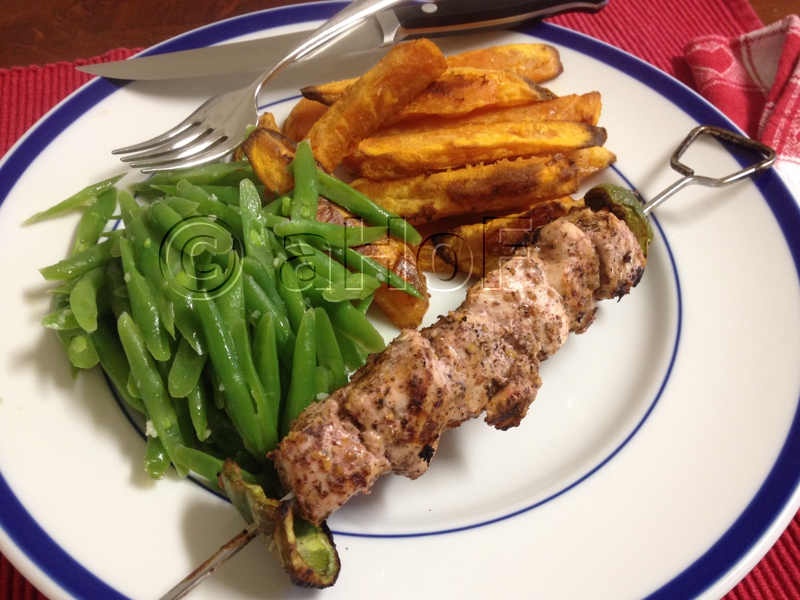
Lemon Zah'tar Chicken served with Sweet Potato Oven Fries and Green Beans
Sumac closely parallels the use of tamarind or dried green mango powder in Indian and Indonesian cuisines. The dried, crushed fruits yield a reddish brown powder that is preferred over lemons for its fruity sourness and astringency. Sumac is a major component of the spice mixture called Zah'tar. Zah'tar is wonderful when mixed with olive oil to use for dipping bread. It can be sprinkled over most any food that needs a little zip. Sprinkle it over hummus, yogurt, avocado or cheese.

Lemon, Zah'tar, Chicken, grilling, entree
Lemon Zah'tar Chicken on the grill
A Syrian acquaintance once made chicken kebabs, marinating them first in a mixture of yogurt, lemon juice, dill, garlic, salt and pepper. She was lamenting the lack of sumac to make her kebabs more authentic. Since I happened to have some, I brought it for her to use. Thinking back on those very flavorful kebabs, I thought the use of Zah'tar would be a great flavor mixture to add to this sort of recipe. Last evening I put this to the test, with wonderful results.

Lemon Zah'tar Chicken


Serves 3 or 4
Kebabs, grilling, entree, recipe, supper
Kebabs, before and after grilling

3 to 4 boneless, skinless chicken breasts

MARINADE:
2 tablespoons olive oil
2 tablespoons Zah'tar
1 teaspoon fresh lemon zest
2 tablespoons fresh lemon juice
½ cup unflavored Greek yogurt
2 cloves garlic, minced
1 teaspoon salt
few grinds fresh black pepper

Cut the chicken breasts into about 1 1/2 or 2-inch cubes. Place the cubes of chicken into a zip-top bag or other container with a lid. In a bowl, mix together all the marinade ingredients until well combined, then pour over the chicken cubes and mix well to coat all sides of the meat. Let the chicken marinate for at least 1/2 hour in this mixture, or up to 2 hours, maximum. After this time the chicken starts to break down from the yogurt and becomes slightly mushy.

Slide the cubes of chicken onto shish kebab skewers, anchoring the meat at the ends with slices of carrot or bell pepper.

Light a grill and once hot, either lower the temperature to medium low, or push most of the coals to one side. Grill over lower heat for about 4 minutes per side, or until the internal temperature is at least 160 to 165 degrees.


While thinking about the recipe for the chicken, I was also thinking of what to serve with the kebabs. I bought a couple of sweet potatoes and made oven fries, similar to my regular Oven Steak Fries. Sweet potatoes, despite being somewhat harder to cut through than regular white potatoes, bake faster than white potatoes. When making oven fries, I like to mix melted butter and olive oil together for the great flavor. The butter could be omitted and all oil substituted. For the Sweet Potato Oven Fries I also added some seasonings, as well as first tossing the raw potato in a little cornstarch. This step was a bit of an experiment. I was hoping for a slightly crisper outside texture. My sweet potato slices were not of even thickness, so some got brown and others did not, but all were well cooked. Just not crisped. I will add the cornstarch to the recipe here; whether to use it is up to you.
Sweet Potato, Oven Fries, recipe, side dish
Sweet Potato Oven Fries

Sweet Potato Oven Fries


Serves 2 to 4

2 pounds sweet potatoes
1 teaspoon cornstarch
1 tablespoon olive oil
2 tablespoons melted unsalted butter
1 teaspoon salt
¼ to ½ teaspoon garlic powder

Preheat oven to 400 degrees (375 on Convection Bake). Peel the sweet potatoes and cut them into thick lengths, as for "steak fries". Sprinkle the cornstarch over the potato pieces and toss well to coat. Place the sweet potatoes in a zip-top bag or other container with lid and pour on the oil and butter, then add in the salt and garlic powder. Seal the container and toss well to coat completely. The potatoes can be held at this point for up to an hour before baking.

Pour the potatoes onto a rimmed baking sheet large enough to hold all the pieces with space between. Bake them for about 10 to 12 minutes. Remove from oven and turn all the pieces over. Return to the oven for another 10 to 12 minutes, or until they are golden and cooked through. Serve immediately.


My passion is teaching people how to create a harmony of flavors with their cooking, and passing along my love and joy of food, both simple or exotic, plain or fancy. I continue my journey in ethnic and domestic cuisines, continuing my journey to explore diverse culinary experiences and hopefully to start you on a journey of your own. Join me also at A Harmony of Flavors on Facebook, and Pinterest.

Disqus