Translate

Showing posts with label baking bread. Show all posts

Saturday, May 31, 2014

Updated Bread Recipe

For a very long time now, I have been making a version of my Mom and Grandma's bread that I have called My Kitchen Aid Mixer Bread. I changed things from Mom's/Grandma's original recipe such as using honey instead of sugar, 3 eggs instead of 3 egg yolks, and powdered milk instead of regular milk. The resultant mixture with the added liquid amounts (honey, eggs) needed a larger amount of flour to make the bread work. From Mom's original 7 1/2 cups of flour, I generally used 8 1/2 cups. Also, back when mom made this bread she usually used cake yeast. I have always used dry yeast packets as it is very difficult to find cake yeast.

vintage recipe, bread recipe, Grandma's recipe
My 40+ year old copy of Mom's bread recipe
While I lived in Guatemala, I made Mom's bread regularly, even when I had no oven, instead using a rack in an electric fry pan to bake one loaf at a time. At that time, back in the 1970s I made the bread by hand, kneading for 10 to 12 minutes. I learned what a really nice dough felt like and what to watch for. When I married my current husband, he bought me a bread machine, an early model by DAK. For a couple of years I used the bread machine relentlessly, cutting the recipe for Mom's bread roughly in half and letting the bread machine do the work of kneading and rising, though I always pulled it out to bake in pans in the oven. After a couple of years, my poor, overworked bread machine died. At this point, my husband finally convinced me to try a Kitchen Aid Mixer (I had declined earlier, thinking I didn't need one - HA. . .). Once I got the Kitchen Aid Mixer, I started making the full recipe again (4 loaves), and a whole new world of baking opened up. I loved that machine and used it for years, until I finally wanted to upgrade to the Pro 600 series with a bigger bowl. I gave my old machine to one of my daughters, who has it still, good as new.

It was during the time with my first Kitchen Aid that I really altered Mom's recipe to use honey and powdered milk. I had not used the order of mixing for a very long time. Mom's recipe called for cutting shortening (or butter or margarine) into the dry ingredients as for pie pastry and then adding the milk, yeast and eggs. I altered this to placing boiling water in the bowl of the mixer and adding a stick of butter from the fridge, with about 1/3 cup honey and salt. Once the liquids cooled sufficiently, I would add the dry ingredients (flour and powdered milk) along with the dry yeast which had been softened with a little warm water. Once these ingredients were all moistened, I added the eggs and then kneaded for 10 minutes. Mom's bread called for two rising times before forming into loaves. I followed this until "Instant" or "Quick-Rise" yeast started making an appearance, and then I switched to one rising time.

My Kitchen-Aid Mixer Bread

Kitchen-Aid Mixer, Bread, bread making, neading, proofing, flax seeds
My Kitchen-Aid Mixer version, with ground flax seed added

Makes 4 loaves

1 stick butter
½ cup honey
½ tablespoon salt
3 cups hot water
2 cups bread flour
1 cup dry milk powder
2 packets instant dry yeast or quick rise yeast
3 eggs
6 - 7 cups more bread flour

In Kitchen-Aid, or other very heavy duty mixer, place butter, honey, salt and hot water, until butter is melted, or at least very soft. Allow to cool to lukewarm. In a large measuring cup or medium bowl, combine the 2 cups bread flour, the dry milk powder & yeast; stir together to combine. Making sure the water in the mixer bowl is not too warm, add in the dry mixture. Fit the mixer with the dough hook and turn on Stir or lowest setting possible to combine. Turn mixer to speed 2 to mix all dry ingredients in and then turn speed down to stir. Add in the eggs, and increase speed to combine well. Begin to add in more flour, 1 cup at a time, until you have added in 4 extra cups. At this point, watch carefully how the dough acts; start timing the kneading period for about 10 minutes from this point. The dough should remain soft, but not too wet. You will probably add in 8, possibly 8½ cups of flour total, but this will also depend on the ambient humidity level. If the dough gets too dry, it will try to climb right up the dough hook. This is more flour than was needed, but you will still get good loaves of bread - don't worry!

Drop the bowl down and remove dough hook. Allow the dough to rest for 1 - 2 hours, or until at least doubled in bulk. If using regular dry yeast, punch down and allow the dough to rise again, until almost doubled in bulk before proceeding.

Flour a surface and pull out all the dough, folding in and over on itself a couple of times. Divide the dough into 4 pieces. Grease 4 loaf pans (4 x 8 or 5 x 9). Take one of the sections of dough and flatten it a bit with your hands. Begin rolling it from one end, tucking it in as you roll, to form a nicely shaped loaf. Place it in one of the pans, repeating with the other three sections of the dough.

If making Bread Bowls for individual serving size, each loaf sized piece of dough is further divided into 4 sections. Tuck the dough under until a smooth round ball is achieved. Place these 4 on a baking sheet, without crowding. If more bread bowls are needed, use another loaf or more, for 4 bowls per loaf.

Allow the loaves to rise until they have risen just above the pan tops or about doubled in bulk. Heat oven to 350 degrees. Bake bread for approximately 30 minutes. Bake Bread Bowls for about 25 minutes, until nicely browned. Once removed from the pan, the loaves sound hollow when the bottom is tapped. Turn the loaves onto racks to cool. When making the 4 loaves, I usually freeze three until needed. 


At times when making the bread I would add in things like wheat bran for fiber, or wheat germ for flavor and nutrition. I started adding in ground flax seed more recently. I have used the basic recipe and turned it into many things over the years, but the recipe was sound and it was delicious. Then about a month back my sister in law brought me some bread baking books, and I started reading Peter Reinhart's "The Bread Baker's Apprentice" and it is changing my way of looking at bread making. Rather radically.

Challah, bread, bread styles, bread making
Challah, made recently

A little over a week ago I made Challah from this book. I had never made Challah before, but the recipe in The Bread Baker's Apprentice was similar to Mom's bread in that it is a rich dough. It was similar to Mom's bread recipe, but with some specific differences. I wondered if somewhere in this book there was a recipe that would be close enough to Mom's bread that I could use the techniques used for Challah in the book. The Challah bread had the most beautiful dough I had ever worked with, and the crumb of the finished loaf was so fine and light. Searching the book page by page, I came across a recipe for Cinnamon Rolls/Sticky Buns; this dough recipe was about ½ the size of Mom's recipe, but had all the ingredients. I doubled the recipe to see how the ingredients stacked up against Mom's recipe. Boy, oh boy was it ever close. Yesterday I made the bread. The method for making the dough was different even from Mom's method, and one I had not used before. It called for creaming together the butter, sugar salt and dried milk powder, adding in the eggs and then the water and flour with instant yeast. 


Updated recipe, Mom's Bread recipe, bread, proofing
My Updated version of Mom's Bread

Following this method, the dough kneaded beautifully. One thing I did that I have never done before was follow the ingredient amounts by weight. I keep seeing this reinforced in any serious baking book. Measure by weight, not by volume. I used the weight measurements and was surprised at how many differences in amounts turned up because of this.

Again, the dough's spring and resilience boded well for the finished loaves. Reinhart's method calls for two rising times, despite the instant yeast. The first rising  is to reach just double the volume of dough; the second rising calls for 1½ times the size. Both times it worked perfectly. The finished loaves came out with a slightly different texture than the Challah, but still with the light springiness and fine crumb. It is so fine and delicate; the loaves came out perfectly. The differences are subtle, but working with this dough was a joy. I do believe I will be using this new method from here on out. I am using the amounts in the recipe that came out from my use of weight vs volume, so many of the ingredients will have odd amounts, using < for "minus". I am adding the weight measurements in parentheses. My normal method for measuring flour is to scoop in the bag, gently sprinkle the flour back into the bag, then scoop the fluffed flour and level the cup. Even with this, I still needed only 6½ cups of flour to make 2 pounds rather than the 7½ the recipe called for. If using milk instead of milk powder, just omit the milk powder at the beginning and use the measure for the water, heating the milk to 90 to 100 degrees to add after the eggs.

Mom's Bread Updated

Mom's Bread, updated recipe, smaller recipe
My Updated version of Mom's Bread


Makes 3 loaves
 

1/2 cup <2 tablespoons sugar (4 oz)
3 teaspoons <1/4 teaspoon salt (.5 oz)
8 tablespoons butter (4 oz), room temperature
8 tablespoons dried milk powder (2 oz)
2 large eggs
2 cups water, 90 - 100 degrees (16 oz liquid)
6 1/2 cups flour (2 pounds)
4 teaspoons instant yeast (.44 oz)

Place the first 4 ingredients in the bowl of a heavy-duty stand mixer and cream them together. Once well combined, add the eggs, one at a time until combined. In a separate bowl, combine the flour and yeast. Pour the water into the creamed mixture and gently stir to just loosen, then add the flour mixture and knead with the dough hook for 10 to 12 minutes. If kneading by hand, knead for about 14 minutes, or until the dough is firm and tacky, but not sticky. Grease a large bowl or dough rising bucket and place the dough in the container, turning to grease all sides.

Cover and let rise for 1 hour, at which time it should have doubled in size. Turn out on a counter or board and knead out all the bubbles for 2 minutes. Return to the container and allow to rise again for about 60 to 90 minutes more or until tripled in volume. Turn out onto a counter or board and divide into three equal portions. Gently press out each portion into a rectangle; try not to completely deflate the bubbles. Roll into loaves and set in greased loaf pans and allow to rise again, until at least doubled in size.

Preheat oven to 350 degrees (325 if Convection). Set loaves to bake for 25 to 35 minutes. Internal temperature should reach about 185 degrees. Turn loaves out onto racks to cool completely before cutting.


My passion is teaching people how to create a harmony of flavors with their cooking, and passing along my love and joy of food, both simple or exotic, plain or fancy. I continue my journey in ethnic and domestic cuisines, continuing my journey to explore diverse culinary experiences and hopefully to start you on a journey of your own. Join me also at A Harmony of Flavors on Facebook, and Pinterest.

Thursday, May 22, 2014

Some Things I Have Been Making Lately

I have been quite busy lately; mostly with baking. When my sister-in-law, Sherri brought me all those cookbooks, mostly on breads, I sort of parked myself in one of them, "The Bread Baker's Apprentice: by Peter Reinhart. I have been so enchanted with the recipes and all the instruction, explanation, theory, chemistry, all the why's and wherefores of bread making. I wrote about this a bit in my blogs of May 1st, and May 2nd, and sporadically since then. 

bread, rye bread, caraway seed, onions
Caraway Deli Onion Rye
I started out making a "seed starter", meaning I mixed flour and water and let the wild yeasts that live in everything around us just come calling and ferment the starter with no help from commercial yeast. Once the starter was ready after 4 days, I proceeded to make the "Mother Starter" which is just a step further, making the starter usable for many of the recipes in the book. The first bread I tried after making the starter was a Caraway Deli Onion Rye. This bread was a fantastic success, doing everything it was supposed to do and the flavors were most amazing. I felt this was an auspicious start, so I proceeded to plan what else to make. One kind of bread I like is the really dense 100% rye. Rye does have some gluten in it, but not as much as wheat, so making anything completely from rye with no help from any wheat flour makes it a far more dense bread. Some groceries carry this kind of bread and I was buying it locally here for a while. 

Once I had finished with the starter, the barm and that first rye bread, and learning the barm could be frozen, I divided up the remaining barm and froze it to have ready at a day's notice and just took a break from the mess all over the kitchen for a few days. I then proceeded to read about more of the rye breads, as I had just bought a pound of rye berries. I decided on making the 100% Sourdough Rye. I got one of the frozen barm starters out of the freezer and let it thaw overnight, then divided that up, using one half to make the rye starter for that bread, and mixing more regular flour and water with the remainder to keep the barm going while I decided what else to make with it. 

sourdough bread, starter, rye bread, no yeast
100% Sourdough Rye: yesterday, loaves formed; today after 5 hours; loaves after baking
I will say, I am not having quite the "quick" response times as the book indicates when it comes to the rye. I mixed up the rye flour starter, and the book said it should take about 4 hours to double in size. I had the starter out the entire day long and it never really rose at all. It sort of relaxed and settled in the container but that was it. Finally late that night I put it in the fridge regardless, along with the refreshed barm. I mixed up the bread recipe yesterday, which indicated another 4 or so hours and the dough should have doubled or possibly gone to 1½ times its size  - NOT - Just wasn't happening. It grew a little. 

sourdough, starter, rye,  bread
100% Sourdough Rye
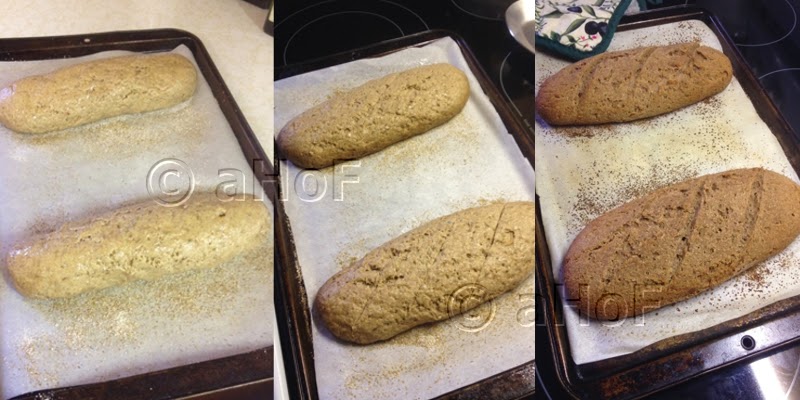
After 6 hours I just formed the loaves and gave it another night refrigerated. At 6:00 AM this morning I got it out to come to room temperature and grow prior to baking; in a perfect world, 4 hours to double in size. That didn't happen either. Oh well. I left it out today for 5 hours and then baked just as indicated, using a very hot oven to start, with a pan of water for steam, opening the oven door after 30 seconds to spray the walls of the oven with more water, then after another 30 seconds, and after another 30 seconds. Then lowering the temperature, the loaves baked just as indicated, rising a bit, but remaining very heavy and dense. I expected heavy and dense, but it seemed the book indicated more growth than took place. Regardless, it is delicious.

bread, making bread, Challah
Beautiful Challah loaves
While watching the 100% Sourdough Rye not doing anything all day yesterday, I decided to try making Challah. I have been making my Mom's (and Grandma's) bread recipe for more than 20 years. It is quite similar, in that it is a rich bread, using a fair amount of sugar, butter and eggs. Though I might have done things differently (as used to my Mom's bread as I am), but I followed the instructions for the Challah in the book to the letter; the dough came together just as stated. After kneading it stretched beautifully to create the "windowpane effect", meaning the dough stretched to a thin membrane without snapping. It grew just as stated, I formed one loaf into a braid and one in a loaf pan. They baked so beautifully I was in awe. They were the prettiest, lightest, most perfect loaves. I was in heaven. And, it tasted fantastic too. My husband said he could live on that bread just fine!

Today I made a batch of dough for pizza. I have been making my pizza dough from the same recipe for just ever. The Bread Baker's Apprentice has you making the dough up using ice water and then forming into individual balls and refrigerating for 1 to 3 days before using. Tomorrow, I am planning to make pizzas. My husband has a way of making his pizza that is certainly any Italian's nightmare. Tomorrow, he's going to have to put up with my idea of what a pizza should be, because with this dough I want to do my best to create a proper pizza. In a couple of days, with more of the dough, he can do his own thing.


My passion is teaching people how to create a harmony of flavors with their cooking, and passing along my love and joy of food, both simple or exotic, plain or fancy. I continue my journey in ethnic and domestic cuisines, continuing my journey to explore diverse culinary experiences and hopefully to start you on a journey of your own. Join me also at A Harmony of Flavors on Facebook, and Pinterest.
Thursday, May 1, 2014

New Books, Breads and Dreams

I have been cooking and baking a lot as usual. That said, I haven't got a specific recipe to share today. I could. I have made many good things that I could share. But everything today is taking a back burner. I am so excited.

Unidentified Bread Pan
To start with, a couple of months ago my sister-in-law brought me a bread baking contraption I had never seen before. Someone came and donated it at the museum, but they had no real use for it, and I am into the old, the new, the different. I have no idea at this time if I will ever use this device. It is a closed, two-loaf affair, making round loaves with ridges. My concern is twofold; first, what kind of recipe would be made in something like this, and second, as these hold a lot of dough, and as it is obviously closed for baking, how would I know if it is baked through? 

If anyone seeing this happens to know what it is for, specifically, or what sort of bread would be baked in this mold - please leave a comment!


When she brought this mold to me, my sister-in-law also noted that at some unspecified time she would have a set of glass tube bread molds to bring. This unspecified time happened to be last evening. In the past I had owned a set of glass tube molds for bread, though they were much smaller in diameter. The ones she brought last night are a far larger in diameter, probably a good 4½ to 5 inches. This would make a more normal sized loaf instead of a "tea bread" loaf. I am interested to try them out.

books, cookbooks, bread recipes,
Stack of Books
Then last weekend, I was helping my sister-in-law to move some furniture out of a storage unit and I happened to notice she had Rose Levy Berenbaum's "Bread Bible" setting on a shelf! OMG! I asked if I could borrow it, and she said, "Certainly. Actually, you can have it." I was in love. I sat to start reading and got teary just reading the introduction. I can so identify with all the feelings about bread making. It enchants me. I have continued to read bits and pieces, along with looking through various recipes I find of interest. I have already learned quite a few things about the chemistry of bread making that I never knew. I have always made bread in the manner my Mom did, and her Mom before her. If I tried another recipe and it didn't work right, I continued to apply the methods I knew and went from there. All in all, with fair success.

But the thing that really threw me into the stratosphere was that she brought over 6 cookbooks, 3 specifically on breads and the rest on other baking subjects. The bread books are large hardback books, with beautiful color photos so very evocative and enticing. They make you want to take a big bite right out of the book, the photos are so wonderful. There are few things that I love more than great books. So, this morning I started reading one of these new books on bread. Reading about the varying types of flour grinds was enlightening. The chapter on making a starter batter from scratch was a revelation.

Oat Groats, Wheat, Rye
Oat Groats front, Wheat and Rye berries behind
Long ago (back in the 80s) I made a sourdough starter and used it to make breads, pancakes, cakes. The starter dough was made using a tiny amount of yeast to jump start the batter. This use of commercial yeast is done often, making it very easy to get a nice batch of soured dough to use to make a loaf. I kept the starter going for some time, but eventually lost interest and tossed it out. In this (new to me) book, there was a recipe for a "seed" starter where you are truly starting from scratch, waiting for wild yeasts to invite themselves in. On reading some of the theory, they explain that rye carries more natural yeasts on the grains than does wheat, so if possible they advocate using rye flour for the initial starter mixture, then adding wheat flour to "feed" this over the next days. Once this mixture has caught the yeasts and is fully alive, it is called a "seed starter." 

Caraway, Rye Bread, bread,
Caraway Rye Bread
I do not keep rye flour or whole wheat flour as they tend to go rancid so easily that most times they already taste off before even using them. I do, however, keep whole wheat berries and whole rye berries in the freezer. I own both a hand grain grinder and a grain attachment for my Kitchen Aid. I found that to make a Rye Bread recipe that caught my fancy, I would need a total of 3 cups of rye flour; one for the initial "seed" starter, one more for the rye bread starter using the barm (the seed starter plus additional flour and water, yet to be made), and another to add later to the actual bread dough recipe. Unfortunately, once I ground the rye berries I still had, it only yielded just over a cup. That's okay though. I ordered some more today and in the meantime it will take at least 3 or 4 days to get the seed starter and then the barm going. The barm does not have a time limit. Once it is made, all that needs be done is feed it occasionally. The rye bread can be made at any time. 

I have made variations of rye breads many times in past: Caraway Rye Bread, Swedish Limpa Rye Bread and others.

Swedish Limpa Rye Bread


Makes 4 round loaves
Swedish Bread, rye bread, limpa rye, recipe
Swedish Limpa Rye Bread


2 packages regular dry yeast
½ cup warm water
2 cups sifted rye flour
¾ cup dark molasses
½ cup shortening
2 teaspoons salt
2½ cups boiling water
6 cups bread flour

Mix the yeast into the ½ cup of water; set aside. Combine the rye flour, molasses, shortening salt and the boiling water and blend well; allow to cool to lukewarm. Add in the yeast to combine, once the temperature is cooled. Begin adding the 6 cups of bread flour to make a soft dough. Turn out onto a well floured surface, cover and allow to rest for10 minutes. Knead the dough for 15 minutes, place in to a lightly greased bowl and allow to rise until doubled in size, about 1½ to 2 hours.

Punch down the dough, cover and let rise again for about 30 minutes. Turn out the dough and divide into 4 sections. Shape the sections into round loaves and place on greased baking sheets, well apart. Let rise until doubled, about 1 hour.

Bake at 350 degrees for 35 to 40 minutes.

NOTES: If you are using Rapid Rise, or Instant Yeast, just add all of the water called for into the second step when mixing the rye flour, molasses, shortening and salt. Add the packets of instant yeast to part of the white flour and mix before adding to the cooled mixture.

If you have a Bread Dough Enhancer, a mixture with a combination of ingredients, including extra gluten to help with rising, add according to directions, into some of the white flour before adding in to the cooled mixture.


Now and again I just get the yen for some nice caraway seed rye bread and I enjoy it for breakfast with jam as much as at lunch for a sandwich. I have used King Arthur Flour's "Sir Lancelot" flour, now simply called King Arthur "High Gluten" Flour when making rye breads in the more recent past, as it has a far higher gluten content and helps with the rising. Rye may have more yeasts, but it has less gluten, necessary for rising. King Arthur Flour also had a product called Deli Rye Flavor, now called King Arthur Rye Bread Improver, which gives more of that real bakery rye flavor to your bread. I have used that also to great advantage. But for the first time ever, this time I am making a real, true starter, waiting for those little elusive wild yeasts to come calling and do their magic for me in the seed starter. For the first time, I will make a starter sponge before diving in with the dough. And for the first time, hopefully, I will be able to create a real, true, deli rye bread that rises properly and tastes great without the enhancement of added flavors. I am just dreaming, totally on cloud 9, waiting for this event to happen.


My passion is teaching people how to create a harmony of flavors with their cooking, and passing along my love and joy of food, both simple or exotic, plain or fancy. I continue my journey in ethnic and domestic cuisines, continuing my journey to explore diverse culinary experiences and hopefully to start you on a journey of your own. Join me also at A Harmony of Flavors on Facebook, and Pinterest.

Friday, April 4, 2014

Beer Bread Turns Out Perfect

I  mentioned a few days ago that I have been trying to prepare for the arrival of 4 guys as guests here next week. Making bread and getting it frozen so it's available at a moment's notice is one way to prepare. I saw a recipe for a bread using a whole bottle of beer, and thought, "most guys like beer, so this should be good". My husband is one exception - he hates beer. Even so, I decided to give it a try and see what the flavor was like. At worst, my husband wouldn't eat it. At best, everyone would love it. 
Beer Bread, bread making, recipe
Beer Bread


I took the concept from that same cookbook that has so often steered me wrong in past, but with the amount of experience I have with making bread, I can usually see when there are problems and correct before they go too far wrong. Sometimes, there needs to be more tweaking, such as with the Cinnamon Raisin Bread I made last week. Eventually it comes out right or I give up the recipe concept as a no-go and leave it at that. The Cinnamon Raisin Bread was wonderfully tasty; no problem there. The only real difficulty was how it rose gigantically and spilled sticky cinnamon sugar butter all over the oven. Easily fixed: make 3 loaves instead of 2 from the recipe.

Sponge, making dough, bread recipe, beer
The Sponge: just mixed; after 30 minutes note bubbles

Back to the Beer Bread. Making a sponge to start with is a nice way to avoid having to knead for a full 8 or 10 minutes. The action of the yeast in the sponge takes on a part of the process. I made the sponge, and let it set for 30 minutes, though 45 minutes would also have been fine. You can see here how it is nice and bubbly after that time. The beer is slightly heated before using it in the sponge. I warmed it on the stove, while prepping the other ingredients. It takes seconds to whisk the sponge ingredients together, just until they are combined. Then you let the yeast do the work for you. After the sponge grows, you add the rest of the flour and knead for another 5 minutes or so, until the dough comes together nicely. 

This recipe uses a long, slow chilled rise after the loaves are formed, which really gives the yeast time to work slowly, and may also contribute to the overall tangy flavor of the bread. You will need room in the fridge for this long rise. Or, if you are still having freezing weather like we are - I set the pan, well covered, in my "sun room," which is at about 50 degrees. All this cold weather is good for something, after all. I set the loaves  onto a chair, and tented flour sack towels from over from the back of the chair to cover the bread. I didn't want the towels to stick to the loaves and chance deflating when uncovered. If you begin making the bread in the afternoon, you may allow the bread to do its slow rise overnight. I started the loaves early in the morning, and baked after 6 hours in the chilled sun room and the bread was done at supper time.

French Bread Pan
French Bread Pan
I have a large French Bread pan I acquired many many years ago, and it is wonderful to use. It keeps the bread nicely rounded and it is long; probably about 15 or more inches. I used the French bread pan to make my Beer Bread, forming the loaves nice and long. I lined the pan with parchment. This was a new idea; something I had never done before with this pan. The pan is perforated so the heat can really get to the crust and make it nice and crisp. Parchment is also porous, so I just gave it a try. I sprayed the parchment with cooking spray before setting the long, formed loaves into the wells. 

After all, the bread came out with a far crispier crust than I have ever managed previously with any loaf. The finished bread did have a slight bitterness at the end, but tastes wonderful. I shared an end with my husband and he liked it very much, despite that slight bitterness. I cannot truly taste beer, but it is evident that there is something very different in the flavor from other French Bread or other loaves of this sort. Here is my recipe.

Beer Bread, making bread, ingredients, beer
Beer Bread - Just out of the oven

Beer Bread


Makes 2 long loaves

SPONGE:
1 (12-ounce) bottle of beer
1½ teaspoons instant yeast
pinch of sugar
1 cup warm water, 100 to 115 degrees
1 cup bread flour

2 cups bread flour
2 teaspoons salt
up to 2 cups more bread flour

FOR BRUSHING LOAVES:
¼ cup water
¼ teaspoon salt

Make the Sponge: Heat the beer briefly to about 110 to 115 degrees, or until it feels nicely warm, not hot, on your pinkie finger. Set aside. In a large bowl, or the bowl of a heavy duty stand mixer, whisk together the 1 cup bread flour, the yeast, pinch of sugar and salt. Whisk in the warm water and then the beer until the mixture is smooth, about 1 minute or less. Set the sponge aside to rise for 30 to 45 minutes, until bubbly. Do not try to speed this process.

Once the sponge is ready, if using the mixer, attach the bread hook and add in the first 2 cups of bread flour and the salt and slowly start the mixer. If working by hand, add these ingredients and stir with a wooden spoon. Once the spoon becomes difficult to work with, switch to kneading by hand. Once these ingredients are well incorporated, begin adding more flour, ½ cup at a time, up to 2 cups, as needed. Knead until smooth. This process should take about a total of 5 minutes. 


bread making, dough, proofing
Loaves risen, after 6 hours; ready to bake
Set the dough into a greased bowl, turning once to coat. If using a heavy duty mixer, just remove the dough hook and leave the dough in the bowl. Cover the bowl with a towel and set aside to rise until about doubled in volume. Do not try to speed the rising process. The rising time should be about 2 hours or so.

Once risen, turn the dough out onto a lightly floured surface. Divide the dough into two equal pieces. Gently knead out the large air bubbles and roll each piece into a log shape, then using palms and a rocking motion, roll out to long narrow loaves. If you own a French bread pan, grease the pan. Line with parchment if desired. Alternatively, grease a baking sheet and strew with cornmeal; set the formed loaves on the baking sheet, well apart. Brush the loaves with oil, then gently dust with a little flour. Make ¼ inch deep slashes diagonally across the loaves, about 4-inches apart. Cover the loaves lightly and set in the refrigerator for 6 to 12 hours for a very slow rise.

To Bake: Preheat oven to 425 (400 on Convection). Remove the bread from the refrigerator. Mix together the ¼ cup water with the ¼ teaspoon salt. Using a pastry brush, gently brush this over the loaves. Set the pan in the oven and bake for 30 to 35 minutes, brushing with the salt water once more about half way through the baking time.  When done, the loaves sound hollow when tapped. If you own an instant thermometer, the internal temperature should be about 204 degrees. 


My passion is teaching people how to create a harmony of flavors with their cooking, and passing along my love and joy of food, both simple or exotic, plain or fancy. I continue my journey in ethnic and domestic cuisines, continuing my journey to explore diverse culinary experiences and hopefully to start you on a journey of your own. Join me also at A Harmony of Flavors on Facebook, and Pinterest.

Friday, March 7, 2014

Oatmeal Raisin Walnut Bread - Yum

Many years ago, when visiting Aberdeen, my sister-in law Sherri asked if I might help her make her grandmother's Oatmeal Raisin Bread. Her mom had this recipe written in her one and only cookbook. Sherri described to me the things she recalled about the bread, thinking that the recipe as written did not - quite - seem like she remembered. It needed more raisins, for one thing. We sat down together and reviewed the recipe, deciding how much to alter the original and finally making a recipe that turned out, to her recollection, fairly spot-on. We decided the amount of raisins could be more than what we used, but that was still fine.

Just a few years back, when Sherri approached me about making a cookbook out of all her mom's recipes so the family could all have copies, I set about deciphering the recipes written in the cookbook. My mother-in-law did not apparently use the cookbook itself, except to write recipes into: in the margins, between lines, inside the covers and any blank spot at all. She also stapled in bits of paper with yet more recipes. Some of the recipes were written in pencil a very long time ago and were barely legible. I had to stand under direct sunlight to catch the shininess of the pencil to be able to read these. Some recipes were written in pen, and then had alternate amounts written above, and sometimes crossed out with other things written alongside. Some recipes were written up to 3 separate times, in three separate places in the book, and sometimes these were differing in amounts or even ingredients. It was quite a task to get these all together.

Oatmeal, Raisins, Walnuts, Bread, recipe
Oatmeal Raisin Walnut Bread
To make matters worse, Sherri's older sister Nancy had many recipes her mom had written on note cards or other scraps of paper and given  her over the years. In many cases, these were so different as to be surprising to have come from the same person. And, on top of that, there were some recipes my mother-in-law either made while visiting me, or sent to me later, and these were different also. I have one way of making her Famous Baked Beans, and my husband swears mine are the best. Yet his sisters' recipes are quite different. 

Which brings me back to the Oatmeal Raisin Bread; there was the original recipe written in my mother-in-law's cookbook. There was the altered recipe as Sherri and I made it (and I had re-made this bread various times over the years), and then there was Nancy's recipe from her mom, which was far different. I created that cookbook for the family. Many of the recipes were ones that Nancy had passed on to her children and they also altered to their taste. Still, it was a labor of love and appreciated, to have all the recipes in one spot. When making some of the recipes and entering them into my website or in this blog, I have given credit to Mom Rawstern when using her recipes, though I have no clue where the recipe may have originally come from. I was planning to make the bread again a few days ago and decided to check the recipes side by side. Nancy's recipe was far larger. It easily made 3 loaves, where the one Sherri and I used made 2 smaller loaves. Nancy's recipe had a whole stick of butter, where the smaller recipe had 2 tablespoons. And on it went. I created my own recipe using the two, side by side, deciding as I went along what I wanted and what not. I added walnuts because I love them. I added some finely ground Earl Grey tea, though I could not find any trace of that flavor in the finished bread. I added gluten, as this is a rich, dense bread that takes some time to rise; the gluten is not necessary, but it helps shorten the rising time and makes the bread lighter-textured than if not using extra gluten. No matter which way, this bread is moist, slightly dense, wonderful as is, or as toast. 

Oatmeal Raisin Walnut Bread


Makes three (8½ x 4½-inch) loaves
dough, rising dough, yeast, bread
Dough after 1st rise


2 cups boiling water
2 cups rolled oats
1 stick unsalted butter
½ cup brown sugar
¼ cup molasses
1 cup cool water
4½ cups bread flour
4 tablespoons gluten, optional
1 teaspoon salt
1 packet (1¾ teaspoons) instant/quick-rise yeast
½ cup dry milk powder, optional

¾ cup walnuts, broken
¾ cup raisins
1 Earl Grey teabag, or 2 1/2 teaspoons loose leaf Earl Grey Tea, finely ground, optional

Into the bowl of a heavy duty stand mixer with a dough hook, place the boiling water, oatmeal, butter, salt, brown sugar and molasses. Let stand for at least 10 minutes. Add in 1 cup cool water and stir. Check the temperature; it should be just warm to the pinkie finger but not hot. If still hot, allow to cool to just barely warm. Separately, combine 3 cups of the flour with the gluten, yeast, salt and milk powder if using. Stir to combine the dry ingredients. When the liquids are no longer hot, add in the flour mixture along with the raisins, walnuts and tea. Set the mixer to knead slowly until combined, then increase speed and allow to knead for 8 - 10 minutes, adding in the remaining flour little by little. Remove the dough hook and set the bowl in a warm place to rise until about doubled in bulk.

Oatmeal, Raisins, Walnuts, Bread, recipe
Oatmeal Raisin Walnut Bread

*If making this by hand, proceed similarly, allowing the first ingredients to cool, then adding the dry ingredients first with a spoon, then turn out onto a surface to knead in the remaining flour, kneading for a total of 10 minutes. Set the dough into a greased bowl to rise in a warm place until doubled in bulk.

Once the dough has risen (2 - 2½ hours), turn out and divide into 3 equal sections. Grease three (8½ x 4½-inch) loaf pans. Form each segment of the dough into a loaf shape and set into the pans to rise again, until about doubled in size, 1 to 1 1/2 hours. Preheat oven to 350 degrees. Set pans in center of oven and bake for 35 to 40 minutes, or until risen and golden brown. Turn out onto racks to cool. Once cooled, the extra loaves may be wrapped and kept in zip-top bags in the freezer for up to 3 months.


My passion is teaching people how to create a harmony of flavors with their cooking, and passing along my love and joy of food, both simple or exotic, plain or fancy. I continue my journey in ethnic and domestic cuisines, continuing my journey to explore diverse culinary experiences and hopefully to start you on a journey of your own. Join me also at A Harmony of Flavors on Facebook, and Pinterest.

Tuesday, February 11, 2014

Make Hamburger Buns at Home

buns, making hamburger buns
Sloppy Joe, Fried Potatoes and Coleslaw
There are times when I get the urge to make something like hamburgers or Sloppy Joes and have no buns. Since I always make our bread, this is no big deal; I just make my own. I had used an old recipe from Better Homes and Gardens for a long time, no matter what I needed in the "roll" department. Once you have a basic recipe, it is very versatile. Make the dough into any shape you please, to fit the occasion. A simple roll dough can be formed into cloverleaf rolls for a nice dinner, buns for a barbecue, or even doughnuts.

Making Cloverleaf Rolls is just a matter of forming a whole lot of tiny dough balls. Fit three little balls of dough into one cup of a greased muffin pan and continue till all the little wells are filled with three dough balls. They bake in no time, being so small. Usually 12 to 15 minutes is enough. To make them extra pretty, brush them with an egg wash before baking. An egg wash can be a whole egg mixed with a couple of tablespoons of water, or an egg yolk with one tablespoon of water. 

How to, forming cloverleaf rolls
To make buns, Use about the same amount of dough as would have been made into three of the little balls, or slightly more. I was uncertain yesterday of how much exactly was needed for each bun, having just invented the recipe. I also weighed the dough. I used just about 3 ounces per bun; this was a little bit too much. The buns turned out great, but a bit larger than usual. I got 16 buns from this recipe, but I believe it would have been better to make 20 or even 24. If you have a scale, try making the balls about 2 to 2.5 ounces each.

Cloverleaf Rolls, shaping rolls, making rolls
Cloverleaf Rolls
My background is Slovak / Serbian. All my grandparents came from "the Old Country". From my Mom's Slovak side, she taught us about "Doughnut Day." Once we knew about it, every year we clamored for doughnuts. Doughnut Day is the Slovak equivalent of Mardi Gras, the day before Lent starts; the last of sweets and other excesses until Easter. And, who can resist a doughnut, hot from frying, dipped in a glaze or rolled in sugar? I mean, REALLY! 

Though my kids were born in Guatemala, where Mardi Gras was an exceedingly pale thing in comparison to, say, the wild excess of Rio, or New Orleans - I taught my kids about Doughnut Day and made doughnuts with a basic roll dough. I also, on occasion have made doughnuts or buns or cloverleaf rolls from my version of my Mom's and Grandma's Pascha. I call my version "My Kitchen Aid Mixer Bread". In essence, similar, in some exchanges of ingredients (honey for sugar, dry milk for regular milk), and the use of my Kitchen Aid Mixer to do the work. It would work with pizza dough, in a pinch. The only real difference is in the shaping. And last evening I was going to make Sloppy Joes, so I needed buns.
hamburger buns, recipe, method
Hamburger Buns, ready for dinner

The other day I made Cinnamon Rolls, and had created a dough I felt would be good for that application. I am sure it would be good as a basic roll dough for any of the already mentioned uses, but yesterday I needed hamburger buns and was thinking of how tender Potato Buns can be. So I altered amounts of some ingredients and added others, using a little potato flour and made a new recipe. It has been exceptionally cold of late. All right, who am I kidding - it has been totally frigid practically since Thanksgiving, with temps soaring down to 24 below and wind chills of -50. When it is that cold, sometimes a yeast dough has a little difficulty rising as quickly as I would like, even with the use of "instant rise" yeast. In mid summer, it is a different story. Yeast dough rises like magic in summer. It took a little longer to get the buns to rise than sometimes, but they turned out most amazingly tender and moist. We had some really fabulous Sloppy Joes! Usually I use the oven with the light on, creating a nice, warm ambient temperature for the dough to proof. However, I had just made my Green Tea Lime Sables, and the oven was just plain HOT, so I couldn't set the dough there to rise. It took about 1½ hours for the dough to rise in the cool kitchen, and at least another 45 minutes for the formed buns to rise. They baked in about 15 minutes. Here is the recipe: 

Basic Potato Roll Dough


Makes 20 - 24 buns


2 cups warm water, not hot
¼ cup honey
1¼ teaspoon salt
4 tablespoons olive oil, or use melted butter or other oil of choice
4 cups Bread Flour, divided
1 packet Instant Rise/Rapid Rise Yeast
½ cup potato flour
¼ cup dry milk powder
1 egg

Heat the water and pour into a large bowl or heavy duty stand mixer, such as Kitchen Aid. Add in the honey, salt and oil. Mix together 2 cups of the bread flour, the packet of yeast, potato flour and dry milk powder. Whisk together well, then add to the warm liquid. Start the mixer, or stir together with a spoon. Once there is a soft batter, add in the egg and beat well. Add in the remaining 2 cups of flour gradually, while either kneading with the mixer's dough hook, or by hand for at least 10 to 12 minutes. The dough may seem very stiff at first. The use of potato flour seems to start this way, but softens later in the kneading process. Set the dough into a greased bowl, turning once to allow all sides to be well oiled. Set in a warm place to rise until doubled in size.

Method, making buns 
Turn the dough out onto a floured surface. Punch down the dough and divide into 4 sections, as equally as possible (or weigh the dough). To make hamburger buns, further divide each section into at least 5 pieces. Form a smooth ball from each piece, then use a rolling pin to roll into a fairly flat disc about 6 inches across. The dough will shrink back on itself. Set each piece onto a greased baking sheet, with at least 3 inches between them (usually about 6 per sheet). I have large "muffin-top" pans, and use those, also. The piece of dough should overlap the little shallow well, but shrink back and fit inside.
 

Set the buns to rise until about double. The centers may not look completely puffed yet, but while baking they will grow. Before baking, if desired, brush the buns with an egg wash and sprinkle on sesame seeds or poppy seeds. Preheat the oven to 350 degrees (325 on Convection). Bake the buns for about 15 minutes, or until puffed and brown.


My passion is teaching people how to create a harmony of flavors with their cooking, and passing along my love and joy of food, both simple or exotic, plain or fancy. I continue my journey in ethnic and domestic cuisines, continuing my journey to explore diverse culinary experiences and hopefully to start you on a journey of your own. Join me also at A Harmony of Flavors on Facebook, and Pinterest.

Saturday, March 30, 2013

Happy Easter, However one Celebrates

We are going to be with family for Easter dinner tomorrow. Every family has its own special Easter foods. My background being Slovak and Serbian had us enjoying ham, kielbasa or other smoked sausage, sirets, beets with horseradish and Pascha bread. My parents and grandparents are long gone now, and my husband's family celebrate with some other foods to accompany their Easter ham. Here is my recipe for Beets with Horseradish:

Beets with Horseradish

beets, horseradish, condiment, Easter, ham
Beets with Horseradish

This combination has been a favored condiment to go with Easter ham (or for me, any time we have ham). It was traditional from my Serbian grandmother, and has remained so with me. I have seen it possibly called Hren, Ren, Chrin and many other things, I do not recall ever hearing it called anything but Beets with Horseradish in our household. This was served as a condiment in my family, to be eaten next to the ham, Sirets, and kielbasa with the Pascha bread. Alternatively, we put it on the ham in a sandwich, which is my favorite usage.

Amount is flexible, make as much as desired

1 (1-lb) can or jar beets, well drained
1 small jar horseradish, start with 1 tablespoon
1 teaspoon sugar

Using a rotary grater (mouli) or hand grater with small holes, shred the beets into a bowl. Add in horseradish, to taste. Use one teaspoon, one tablespoon, or however much to make is as hot as you will enjoy. Add in the sugar, to taste. Pack into jars for use over Easter with the ham.


NOTES: If the beets are pickled, meaning they already have sugar added, the added sugar is not necessary in this recipe.


egg dying, silk dye, Easter
Silk Dyed Eggs
However it is celebrated, one never forgets their roots, and it is always good to have some of those comforting things amid all the rest. I made my beets with horseradish. Just cannot live without that when it comes to ham. I made my Pascha loaf to take to my sister-in-law. I don't bother making lots of Easter eggs. I do not have any small children around to have Easter egg hunts. I did, however, make some silk dyed eggs after watching The Chew on TV the other day. They turned out really lovely, and they can be decorations at any time of the year.
yeast bread, enriched bread, Easter bread
Pascha Bread (Mom's Bread Updated)

As my contribution to the Easter dinner tomorrow I was asked to make Hot Cross Buns. Though I have been making bread for over 40 years now, Hot Cross Buns are one iteration I had not made before. I used the recipe from my husband's grandmother. It is very similar to the recipe for my Mom and Grandma's Pascha bread, but I decided to follow the Hot Cross Buns recipe as it was written. They look wonderful, so I imagine they will taste great, too.


hot cross buns
Hot Cross Buns
Since neither my husband nor I need extra sweets around the house, I have long since stopped buying Easter candies. However, for the sake of recipes to go in my website or blog, I have been wanting to make Brigadeiros, a Brazilian Truffle, for a long while. I made them yesterday, and they are as good as I recalled, though it has been a long time since I made my recipe last, 

Brigadeiros

caramel, candy, Brazil, truffle
Brigadeiros

These Brazilian truffles are about as quick as is possible for a caramel type candy. Traditionally rolled in chocolate sprinkles, they may be rolled into any coating desired. I used chopped pecans for some here. These are my token Easter candies this year.

Makes about 15 - 20 truffles

1 (14 ounce) can sweetened condensed milk
2 tablespoons cocoa
1 tablespoon butter
sprinkles or other for coating

Mix ion a medium saucepan the milk, cocoa and butter. Bring to a boil, stirring vigorously so it does not stick to the pan. Continue stirring constantly for about 10 to 12 minutes, or until the mixture starts to pull away from the sides of the pan and clumps around the spoon.

Allow to cool slightly and scoop out balls about 1 inch in diameter. With buttered hands, roll the mixture into a neat ball and roll into the coating of your choice.

The other thing I made to take to Easter dinner is a lemon meringue pie. Last year I was asked to bring a lemon meringue pie and a coconut cream pie. Both were hideous messes. Both the fillings turned out hopelessly runny. I tried to make an Italian Meringue and failed at that. I tried making a stabilized whipped cream and ruined that. Alas. No matter how good a baker I am, and I pride myself on my baking, those two types of pies are not ones I have ever really made. I recall living in Guatemala, once making a lemon meringue pie. I used an old fashioned egg beater to whip the meringue. I like lemon meringue pie, though I am not wild about meringue, itself. I cannot recall how it turned out, overall. I love coconut cream pie, but as luck has it, my husband does not like coconut, so I have not made one of those. In the course of this last year, I found Rose Levy Berenbaum's Lemon Curd recipe. It comes out beautifully firm, so I used that as the filling for this year's pie. I also found references to making a meringue with cooked cornstarch to stabilize it. The pie looks good. Tomorrow I will find out how these things came out!

For now, I am sharing photos of some of the things I made, and hope all of you have wonderful foods to share this Easter 2013.


My passion is teaching people how to create a harmony of flavors with their cooking, and passing along my love and joy of food, both simple or exotic, plain or fancy. I continue my journey in ethnic and domestic cuisines, continuing my journey to explore diverse culinary experiences and hopefully to start you on a journey of your own. Join me also at A Harmony of Flavors on Facebook, and Pinterest.

Disqus