Translate

Showing posts with label peppers. Show all posts

Sunday, July 10, 2022

Veggie Kebabs as Main or Side Dish

If you love grilled vegetables, then this is a recipe for you. Whether you are vegetarian, or if you want these as a side dish, they have excellent flavor, both from the marinade and from the grill. 

grilling, kebabs, vegetables, main dish, side dish
Veggie Kebabs

When I made these, I used a mix of vegetables I had selected just for this application, but you can mix and match as you choose, keeping in mind that not all vegetables cook at the same rate. I used tiny potatoes whole, so I first boiled them and then marinated them to use on the skewer just for the added flavor of the grill. I used chunks of fresh pineapple, obviously not a vegetable but it does taste great on the grill! Bell peppers are an easy choice, and multi colored peppers make the kebabs look more visually appealing. I used hunks of portobello for the meatiness, but button mushrooms or cremini mushrooms would also work - or no mushrooms at all if they are not to your taste. Corn is best cut into small rounds across the cob, both for easy skewering and for quicker cooking, as more heat can reach the kernels. Sweet potato also needs a little cooking beforehand to make them soft enough to grill, just being careful not to over cook or they won't stay put on the skewer. I love grilled onion, so the more the merrier, whether white, yellow or red, and cut into wide enough squares to be comparable in width to the other vegetables on the skewer. 
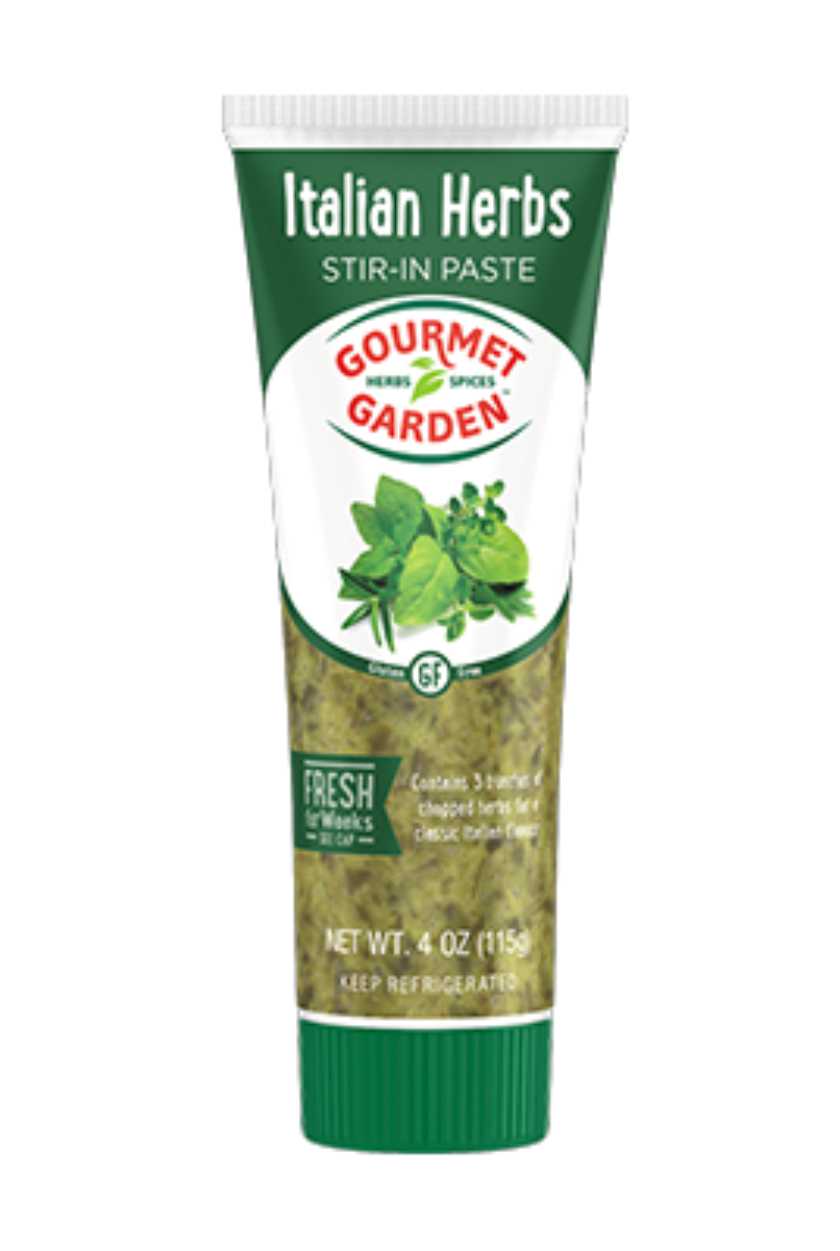
Gourmet Gardens Italian Herbs
I happened to have on hand at the time a tube of Gourmet Garden Italian Herbs. If you have not used this mixture, it is really great to give flavor to all sorts of foods, whether steaks, baked potatoes, mix into a dressing - just use your imagination. Once you've tasted it, you will think of all kinds of things it would enhance. Our friend Rich is a fanatic about this stuff and has it on hand at all times, for stirring into vegetables, adding to sauces, to spread on pizza, whatever strikes his fancy. 

I tried once to make an approximation of this stuff, and it was okay, but somehow fell just short of the mark, for flavor, despite using fresh herbs to create it. The only actual herbs in this mixture listed on the label are basil, oregano, parsley and rosemary, out of 10 total ingredients, so you may understand why I wanted to go that route of making my own. 

👀My suggestion, if you do not have this ingredient, or choose not to use it because of the many "other" ingredients, would be to substitute a tablespoon of minced fresh basil and rosemary with another dollop of olive oil to approximate - as my recipe already calls for oregano and thyme, garlic, balsamic vinegar and olive oil. 

Veggie Kebabs


Makes about 10 to 16 kebabs, depending on size of skewers
grilling, vegetables, kebabs, main dish, side dish, vegetarian
Veggie Kebabs


1 – 2 ears corn, cut into 1½ inch wheels
1 red bell pepper, in 1-inch squares
1 orange bell pepper, cut in 1-inch squares
1 red onion, separated and cut in 1-inch squares
1 zucchini, cut into 1-inch cubes
6 (3-inch) Portobello caps, quartered
15 – 20 tiny 1-inch potatoes, or others, in 1-inch chunks
1 sweet potato, peeled, in 1½-inch cubes
2 cups fresh pineapple, in 1½-inch wedges

MARINADE/SAUCE:
1 teaspoon Kosher salt
1 tablespoon fresh chopped oregano
2 teaspoons fresh thyme leaves
2 tablespoons olive oil
3 tablespoons balsamic vinegar
3 tablespoons Gourmet Garden Italian Herbs 
(or see above ðŸ‘€)
3 cloves garlic, smashed and minced

Place the potatoes and sweet potato chunks into a small pot and cover with water. Bring to boil, adding 1 teaspoon salt to the water, and boil for about 10 minutes, or until they can just barely be pierced through. Drain and rinse under cold water and set aside to cool.

In a bowl, whisk together the Kosher salt, fresh oregano & thyme, olive oil, balsamic vinegar, Italian Herbs paste and garlic. Whisk together and pour over all the vegetables in a large bowl. Toss to coat. Thread the vegetables onto skewers, keeping in mind, if using wooden skewers, they must be soaked for at least 30 minutes before using. When threading the corn, skewer it through the center of the “wheel.” Reserve the marinade aside.

Grill the skewers over a hot grill until they are browned in spots and tender. Brush them with some remaining marinade to serve. Or, remove the vegetables to a bowl to serve, pouring some of the remaining marinade over top.

NOTE: As a party idea, use small wooden skewers, well soaked ahead of time, and thread on just a small few veggies per skewer, Make extra marinade to have for guests to use as a dip or a pouring sauce when serving. As these do not have to be hot for serving, they can be made just slightly in advance, but do not make them so far ahead they need refrigerating, as this significantly changes the flavors.


My passion is teaching people how to create a harmony of flavors with their cooking, and passing along my love and joy of food, both simple or exotic, plain or fancy. I continue my journey in ethnic and domestic cuisines, continuing my journey to explore diverse culinary experiences and hopefully to start you on a journey of your own. Join me also at A Harmony of Flavors on Facebook, and Pinterest.

Friday, July 10, 2015

More Ferments and Yet More

After my first couple of experiments with fermenting foods, both as a means of preservation and (more importantly) a source of myriad probiotics, I decided to take the plunge and try fermenting some other things. Those first two experiments, namely my Apple Sauerkraut and Piccalilli, made me rethink flavors, as my taste buds were treated to such completely new and different tastes as I was hard-put to describe. It was truly tasting something for the first time; there was no point of reference.
fermenting, rhubarb, onion, spritzers,
Rhubarb Fig Chutney, Pink Onion Relish, Strawberry Spritzer, Salsa Verde, Hot Pepper Salsa

I am now heartily on the bandwagon in favor of lacto-fermentation. My first introduction to this type of preservation (one of the most ancient, and safer than home canning) was by way of The Art of Fermentation, by Sandor Ellix Katz. I am very glad I read his take on things first, as I am heartily in agreement with the idea that we live in a world of hand-sanitizing, so caught up in the war against bacteria, germs and viruses, we have become a culture that succumbs far too easily to any allergy and auto-immune disease, not to mention all other diseases. Our immune systems are meant to be strengthened. Ours have become so lax, they don't quite know how to handle anything that comes along. And all of this strengthening begins in the gut. I read an article in yesterday (site no longer available) that also stated these thoughts, much more coherently:
"What we do know for sure is that our Western fixation on sanitation may have some disadvantages. Inflammatory bowel disease (Crohn’s and colitis), asthma, and autoimmune disorders are far more common in ultra-sanitized nations. There is one hypothesis–the “hygiene hypothesis”–that suggests that less childhood exposure to bacteria and parasites in the US and Europe may actually interfere with immune development. Because of antibiotics, antibacterial products, and overall hygiene, we don’t have as much interaction with the bacterial species that may help to keep our guts balanced. Of course, this isn’t the only reason that Western nations display more signs of dysbiosis (imbalanced gut flora): medications, artificial foods, diets high in refined sugar and saturated fats, stress, constipation, and deficient dietary fiber are also associated with the condition."

Understand, mine are not claims backed up by personal research, beyond Katz's book and many internet sites, and when searching you are just as apt to find dissenters, or fear-mongers as those who are pro-fermenting. To be fair, most are not against fermenting foods, per-se, but just that they feel everything has to be absolutely sanitized, using only certain types of jars or crocks, due to one thing or other, where Katz has a more laid back attitude. I am in agreement completely with the fact that things should be clean. That is my first rule in the kitchen, when cooking anything at all. Cleanliness is great. Absolutely sterile conditions (according to The Art of Fermentation) can inhibit the ability of the food to ferment properly. And, while I like cleanliness, I am not a slave to it.


fermentation, fermentation process
Hot Pepper Salsa  Left: Salsa just packed in jar; Right: after 2 days, active bubbling      

I apologize if I get carried away, My new hobby has got me firmly in its grip! Long and short is, I changed two things (well, maybe three) in the last month. I have not been eating almost any bread or desserts (or sugar, beyond a teaspoon of honey once or twice a week) beyond incidentally here and there, and I introduced my sauerkraut and piccalilli into my diet daily. Since then, I have lost seven pounds. I had already been trying to eat more healthily and eliminate sugars as much as possible, due to very high blood glucose numbers. I finally had to break down and go to a doctor to get back on meds. I hate the very idea of being dependent on meds for anything, so this was a huge concession. 

I fully intended, even before heading to the doctor, to make some radical changes in my diet. Knowing what one must do, and actually DOING it are two radically opposing thought processes. Now that I have started, I am more than pleased with the results. But, eating either sauerkraut or picalilli daily, no matter how delicious, gets old. I wanted some new flavors. So, I got busy over the past week and now have fermenting on my counter a Hot Pepper Salsa, a Pink Onion Relish, Salsa Verde and a Serbian Pepper and Eggplant Salsa called "Ajvar". I bought 2pints of jalapenos yesterday at the Farmers' Market and will ferment those also. I was amazed at how very active my Hot Pepper Salsa was after only 2 days! I used  8 different kinds of peppers, from hot to absolutely mild in the mixture. I am calling it Hot Pepper Salsa because it has hot peppers in it, versus the Ajvar, with only sweet red bell peppers. Here is my recipe:

Fermented Hot Pepper Salsa


Makes about 1½ quarts


Prepping, vegetables, salsa, fermenting
Prepping the salsa
1 pound Rustico sweet red peppers (3 cups, chopped)
8 ounces Red onion (1½ cups, chopped)
8 ounces Fresno chilies (1½ cups, chopped)
8 ounces Jalapeno chilies (1½ cups, chopped)
8 ounce red bell pepper (1½ cups, chopped)
5 ounces Poblano chili (1 cup, chopped)
3.6 ounces banana peppers (½ cup, chopped)
3.5 ounces Anaheim chili (½ cup, chopped)
4 large cloves garlic, minced

1 large bunch fresh cilantro, chopped
0.46 ounce coarse sea salt (about one tablespoon; weigh rather then measure)
¼ cup whey (drained from yogurt)
juice of one juicy lime, about 2 tablespoons
2 dried chipotle chilies, whole
1 cabbage leaf to cover the veg in the jar

Weigh the vegetables once already cleaned, stems and seeds removed where desired. I chopped all the peppers and veg by hand, as I wanted to retain the shape and keep everything uniform. The ingredients may be chopped in a food processor or blend smooth if preferred. If blending smooth, it is far more difficult to ferment without the possibility of mold forming. I plan to blend some of this ferment once it is done. For now, I can keep the veg submerged in its brine far more easily this way.
Combine all the prepared vegetables (except the chipotles and the cabbage leaf) in a bowl and stir in the salt, whey and lime juice. Stir well to distribute the salt and allow the vegetables to begin creating their juices, about 10 or 15 minutes. If opposed to whey (which acts as a starter to get fermentation kick-started), there are vegetable starters available, or you may add more salt, or if you have already fermented sauerkraut, use some of that fermented brine with already active bacteria.

Pack the vegetables and any accumulated juices in two clean quart jars, or one larger jar (I used a 50.75 ounce Fido jar). Allow plenty of headroom (minimum 3-inches!), as this ferment makes a LOT of juice. Insert the whole chipotle peppers into the jar(s). Press down firmly to compact the vegetables and press out more juice. The goal is for the juice to completely cover the vegetables. Top with a cabbage leaf, tucking it firmly around the edges of the food to keep it contained and under the brine. Place a weight on top of the cabbage leaf, to help keep the vegetables submerged. They will float upwards after a day or two, but must remain submerged. 

If you have the Fido jar lid with a hole drilled, the grommets and an airlock valve, this is ideal. This ferment is very active, even after only 2 days and will release large amounts of carbon dioxide. IF you have only regular lids, ensure that no metal is exposed to the food or the brine and be sure to loosen the seal daily to allow gases to escape. 

Ferment the salsa for 2 to 10 days, as desired. Taste to determine when is best for you. After your determined time, refrigerate the salsa, but (according to Katz) try not to taste for 3 months at least, and better still, 6 months, for the absolute best flavor.


My passion is teaching people how to create a harmony of flavors with their cooking, and passing along my love and joy of food, both simple or exotic, plain or fancy. I continue my journey in ethnic and domestic cuisines, continuing my journey to explore diverse culinary experiences and hopefully to start you on a journey of your own. Join me also at A Harmony of Flavors on Facebook, and Pinterest.

Disqus