Translate

Showing posts with label molasses. Show all posts

Sunday, September 4, 2022

Muffins so Very Delicious and Low Fat

Muffins are really good. Still, I generally prefer biscuits or scones. Once in a while, I see a recipe and think I might try it, then somehow, it just doesn't happen. 

A few nights back, I was looking through Facebook, and came on a recipe for Turmeric Carrot Muffins with Chia & Coconut, from VeganRicha. Just the title alone had me riveted, right there, because each ingredient in the title is one I use regularly, and love. If you are vegan, or must be gluten free, please check out her recipe by clicking on the link to her recipe, above.

muffins, breakfast, bread, carrot, turmeric, ginger, chia, coconut
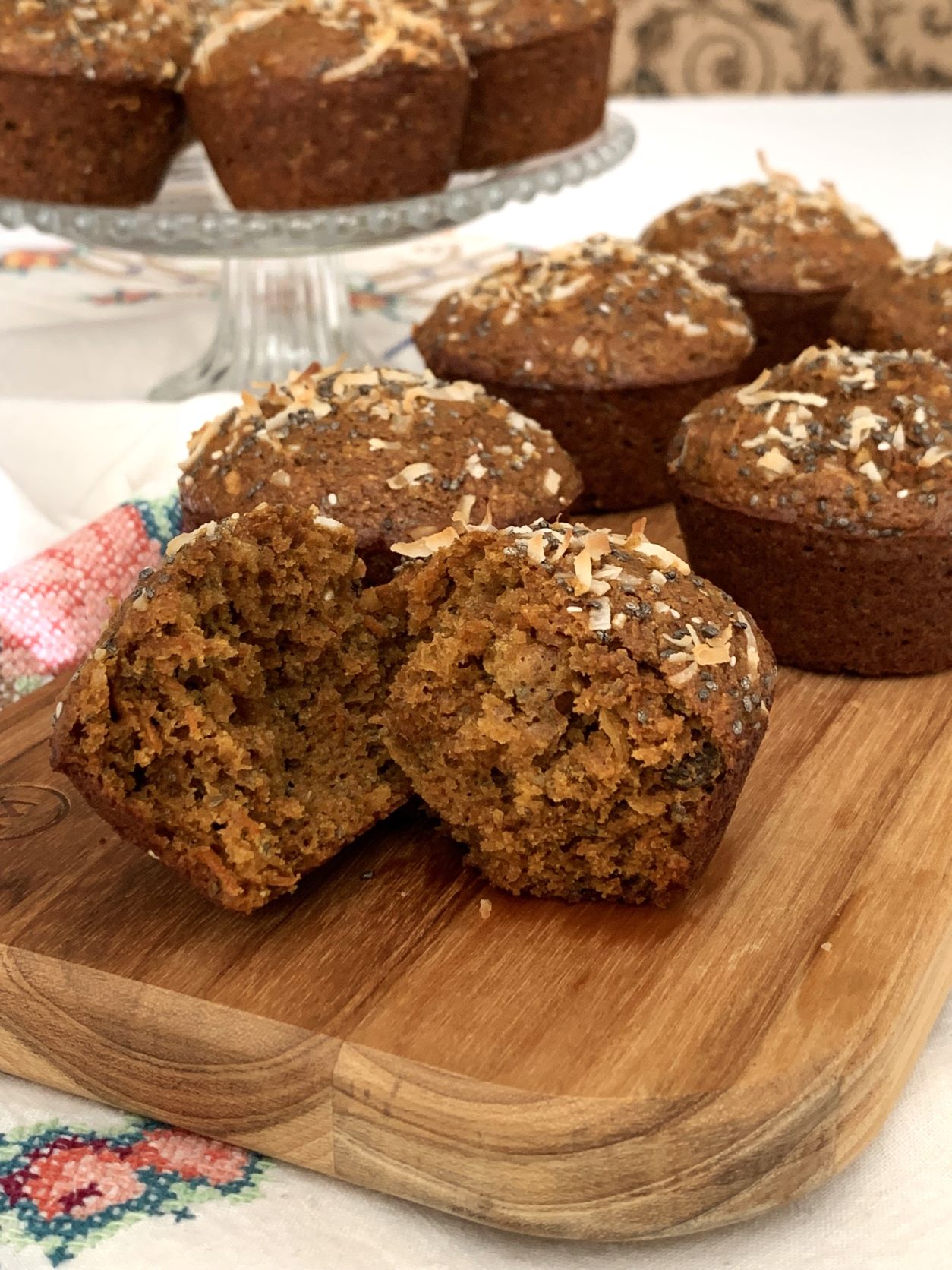
Turmeric Carrot Gingerbread Muffins

Okay, I looked up the recipe and saved it, and apparently my subconscious mind percolated and filtered through the recipe all night and into next day and finally I sat to think it through with my conscious mind. First off, I am not vegan, or vegetarian. Secondly, I don't have to be gluten free. So, I could make the recipe without those strictures, making it more a regular muffin recipe. I opted to use eggs. If milk was needed I would use it instead of a nut milk or coconut milk (I absolutely love coconut milk, but didn't want to open a can to use only a half cup!).

As it all turned out, I changed a lot of things. I truly didn't deviate much from the spirit of the recipe. I used almost everything in the recipe as stated, but changed amounts. 

  • I used a tiny bit more oil, but added a little snack cup of applesauce. 
    muffins, breakfast,  bread, ginger, turmeric, coconut, carrot, chia
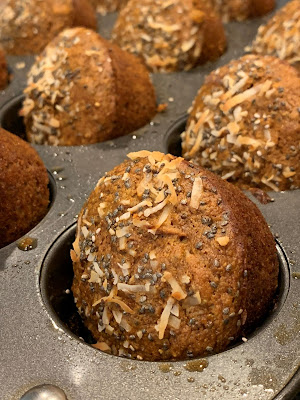
    Turmeric Carrot Gingerbread Muffins


  • I opted to not use maple syrup, as it is expensive and I can never tell by taste that it is even in a recipe like this. I waffled between using honey or agave syrup, then switched to molasses. 
  • Mixed spices were in the original recipe, and cardamom, cinnamon and nutmeg mentioned as possibilities. I changed this to cardamom and ground ginger. 
  • I used a fair bit more fresh ginger than called for as well, as I truly love ginger. 
  • As the recipe called for coconut milk and lemon juice, I changed that to buttermilk, thereby eliminating the lemon. Lemon would bring acidity up to work with the baking soda, but buttermilk will as well.
  • I used more flour, as I was adding both eggs and applesauce, so it was 2 cups of flour total. I used 1 cup of a mixture of barley and buckwheat flour, and the other cup plain all-purpose flour. If preferred, use all purpose flour for the whole 2-cup amount, or substitute whole wheat or other whole grain flour for part of the whole amount. In another attempt, I may use a bit of wheat bran as a part of the two cups of "flour."
I will caution that this recipe needs initial prep work, in that there are so very many little amounts of things to be measured out. I got out all my little cups I use for measuring out sets of spices and things (I save the little 1/2-cup applesauce snack containers for this type of use) and set out all the individual dry ingredients (mixed spices, raisins, coconut, chia, sugar, and the freshly grated ginger). I set the finely grated carrots in a bowl (Richa's recipe calls for blending carrots and other wet ingredients together, but I see no need for extra dirty utensils).

Ultimately, having used extra fresh ginger as well as adding dry ground ginger, along with the molasses, made these smell like the most heavenly gingerbread as they baked. All the extra textures and flavors, while not eclipsed completely, do give great texture. Carrots always make cakes moist, and that works here as well. These are exceptional muffins, and exceptionally good. Thank you Richa, for such an amazing combination!

Turmeric Carrot Gingerbread Muffins


Makes 12 muffins
muffins, breakfast, recipe, carrot, turmeric, coconut, chia, ginger
Turmeric Carrot Gingerbread Muffins


DRY INGREDIENTS:
1 cup all purpose flour (130 grams / 4.6 ounces)
1 cup whole grain or other flour, or simply use all purpose flour
1/2 teaspoon salt
2 teaspoons baking powder
1/2 teaspoon baking soda
3 tablespoons chia seed (32 grams / 1.15 ounce)
1/4 cup sugar or palm sugar (41 grams / 1.4 ounce)
1/4 cup raisins or chopped dates (34 grams / 1.2 ounce)
1/4 cup dry, unsweetened coconut shreds (18 grams / 0.65 ounce)

SPICES:
1 teaspoon ground cardamom seeds
1 teaspoon turmeric powder
1/2 teaspoon dry, ground ginger

WET INGREDIENTS:
2 carrots (155 grams / 5.25 ounces), finely grated
1/3 cup molasses
1/2 cup buttermilk
1/2 cup plain applesauce
2 tablespoons sunflower oil or coconut oil
1-inch fresh ginger, finely grated (15 grams / 0.55 ounce)
2 large eggs
--------
1 1/2 teaspoons each chia seed and shredded coconut for topping, optional
muffins, recipe, breakfast, carrots, chia seed, coconut, turmeric
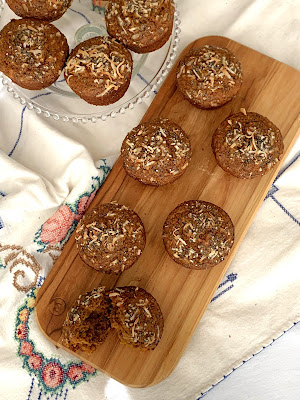
Turmeric Carrot Gingerbread Muffins


Preheat oven to 400 degrees. Grease, or spray with cooking spray, the wells of a 12-well muffin tin. Set aside.

This is easiest to first measure out all the little ingredients and have at hand, "mise en place." A personal choice, but recommended.

In a medium mixing bowl, place all the dry ingredients together, plus the spices and stir together.

In another bowl, combine all the wet ingredients and stir well to combine, then pour all the wet into the dry ingredients and mix with a spoon or silicone spatula until no dry ingredients remain. Fill the muffin tin wells equally - the mixture is very generous. Separately, sprinkle some of the coconut for topping over each portion of batter, then repeat with chia seed.

Bake the muffins for 12 to 15 minutes. Test with a toothpick, as for cakes, at about 12 minutes. Remove from oven and set aside to cool for 10 minutes before trying to remove from the tins. (Muffin papers may be used, if preferred.) After 10 minutes, the muffins will release from the tins with very little coaxing. Set them aslant in the wells to continue cooling. Store at room temperature for up to 2 days, or freeze some in zip-top freezer bags for another time.


My passion is teaching people how to create a harmony of flavors with their cooking, and passing along my love and joy of food, both simple or exotic, plain or fancy. I continue my journey in ethnic and domestic cuisines, continuing my journey to explore diverse culinary experiences and hopefully to start you on a journey of your own. Join me also at A Harmony of Flavors on Facebook, and Pinterest.

Wednesday, March 18, 2015

Time for an Anadama Bread Update

Anadama Bread: heard of it? I had heard of it long, long ago, and even tried making it once, when recently back in the US after living in Guatemala. The problem is that I really don't care for molasses. I use it, don't misunderstand. I just use it very sparingly. The other notable ingredient is cornmeal.

The Story of Anadama

Anadama bread, molasses, cornmeal, seeds
Anadama Seed Bread
The story of how this bread came to be called "Anadama" is different, depending on where you've heard or read it. All the stories have some similarity, dealing with a Massachusetts man, angry with his wife and stating, "Ana damn her!" and thus the bread was shortened to Anadama. Some of the stories say that Ana began making bread but decided to leave, whereupon her husband came home and tried to finish the bread, calling out "Ana dam her". Others say that the husband was tired of cornmeal mush and molasses every day and tried adding some yeast and flour and making a bread, using the same epithet. The stories all vary just a little, but all of them deal with cornmeal and molasses and finally becoming bread - which then became famous, somehow. 
 
anadama bread, cornmeal, molasses, texture
beautiful texture

As I said earlier, I did try making this kind of bread once over 30 years ago. I have had no great urge to repeat the experiment until very recently. The same bread baking book I have been rhapsodizing over for more than a year now is the reason I became interested in trying this bread again. In The Bread Baker's Apprentice, by Peter Reinhart, there is a recipe for Anadama bread, with Mr. Reinhart's own version of how this bread came to be. As I have made over a dozen kinds of bread from this book, ALL of which have been splendid examples of bread creation, I figured that the recipe for Anadama Bread might just be something I would wish to try again. Mr. Reinhart advises that one find the very lightest molasses possible. This, alone, made me trust that maybe this recipe would be a better version than what I had tried so long ago.

Still, I waffled on actually making the bread. I would periodically look at the recipe, and then turn to something else instead. And so passed a year. And then I got one of my cooking magazines in the mail, and what should I find inside? A recipe for Anadama Bread! This one though, had a little twist: the addition of seeds. They used light and dark sesame, light and dark flax and poppy seeds. I love seeds in breads so this sounded wonderful. I have light and dark sesame seeds, but had no flax except ground. Since flax seeds will pass right through a person without ever breaking down to yield their health-giving properties, I figured using pre-ground seeds would be a good idea anyway. I left out the poppy seeds, only because there wouldn't be enough of them to really taste, with everything else going on in this bread. I do love poppy seeds in things! I thought it would be a waste to use them here.
 
Anadama Seed Bread, baked bread, molasses, cornmeal
fresh from the oven

Creating a Recipe of My Own

When I read this recipe for Anadama Bread with seeds in my magazine, I wondered what differences there would be, between the recipe in my revered book and the recipe in the magazine. (I keep saying "magazine" because I cannot recall if it was Food and Wine or Bon Appetit). I got out the book and sat comparing the two recipes. I was amazed at how vastly different they were. The ingredients are much the same: flour, cornmeal, molasses, yeast. Little variances: the addition of milk or not, seeds or not, etc. 

I decided I would create a recipe of my own, walking a line of sorts between the two recipes. Since my tolerance for full flavored molasses is very low, I opted to use half molasses and half honey for that portion of the recipe. I went in between with other ingredients: neither as much as one, or as little as the other. It is a straightforward bread, mixed, allowed to rise, form, shape and bake. No exceedingly long "sponges" that need to grow for a day or more. Nothing difficult at all. I've made bread for so long that it is a way of life for me (though my whole foundation for this way of life was my Mom's bread: said foundation was shaken to the core with Mr. Reinhart's book). I know the basics. I know how a yeast dough works, how it looks and feels. 

Once I had decided on the amounts for my version of this bread, I went to work. I made up the dough; the recipe worked splendidly. It grew nicely, rose beautifully in the pans and baked perfectly. I allowed the bread to cool and sliced it. The flavors were wonderful. While I cannot specifically taste the seeds, they do make for a lovely presentation. Whether the seeds (optional in any case) are added or not, my version of this bread is all I hoped. And I hope some of my readers might try it out!

Anadama Seed Bread

Anadama Seed Bread, cornmeal, molasses, yeast bread
Anadama Seed Bread

Makes two (4 x 8-inch) loaves
 

1½ cups (210 g / 7.4 oz) yellow cornmeal
1½ cups (12 fl. oz.) warm water
------------
3 cups (420 g / 14.8 oz) bread flour, divided
2½ teaspoons (8 g / 0.28 oz) instant yeast
½ cup (120 ml / 4 oz) water
------------
4 tablespoons (60 ml / 2.8 oz) light molasses
(or use half each molasses and honey)
1½ teaspoons (6 g / 0.21 oz) fleur de sel or coarse salt
3 tablespoons (19 g / 0.67 oz) softened butter
2 tablespoons (20 g / 0.71 oz) white sesame seeds
2 tablespoons (20 g / 0.71 oz) black sesame seeds
3 tablespoons (22 g / 0.78 oz) flax seeds, ground
------------
½ cup (70 g / 3.0 oz) bread flour, if needed

In a large mixing bowl or the bowl of a heavy duty stand mixer, stir together the cornmeal and war water. Allow these ingredients to soak for 1 hour to soften. After the hour, add in half the bread flour, with the instant yeast and the 1/2 cup of water. Stir well and allow to ferment for an hour.

Add in the remaining half of the 3 cups of flour with the salt, molasses (and honey if substituting part), the butter and the seeds. Stir these ingredients until they come together. If mixing by hand, turn dough out onto a floured surface, using some of the last half-cup of flour as needed. Knead the dough for 10 to 15 minutes. If mixing in a heavy duty mixer, set dough hook in place and begin kneading at lowest setting, slowly increasing to setting 2 or whatever speed is recommended for kneading bread. Add in the remaining half-cup of flour if needed, until the dough comes together well. Continue kneading for 8 to 10 minutes. The resultant dough should be tacky but not overly sticky.

Grease a large bowl and place the dough into the bowl, turning once to grease all sides. Cover with plastic wrap and allow to rise for approximately 90 minutes, or until doubled in size.

Grease two (8.5 x 4.5-inch) loaf pans with cooking spray and sprinkle with cornmeal. Set aside. Turn the dough out onto a floured surface and divide in half. Form each half into a smooth loaf, flattening the dough and then rolling tightly. Tuck in the ends. Place each loaf into one of the prepared pans. Spray the tops of the loaves with cooking spray and sprinkle liberally with cornmeal. Cover the loaves with plastic wrap and allow them to rise until the dough shows at least 1-inch above the rims.

Preheat oven to 350 degrees. Set the loaves on a lower-middle rack and bake for 20 minutes. Rotate pans, for even baking and bake for another 20 minutes, or until the loaves are golden and test 185 - 190 degrees with an instant read thermometer inserted into the centers. Turn loaves out onto racks to cool before slicing.


My passion is teaching people how to create a harmony of flavors with their cooking, and passing along my love and joy of food, both simple or exotic, plain or fancy. I continue my journey in ethnic and domestic cuisines, continuing my journey to explore diverse culinary experiences and hopefully to start you on a journey of your own. Join me also at A Harmony of Flavors on Facebook, and Pinterest.

Tuesday, September 9, 2014

Another Book and Another Bread

books, gifts, cookbooks, bread baking books
gifted stack of bread books
For anyone reading my blogs in the past months, you will probably already know I have been on a bread baking mission. After being given 7 books on artisanal bread making/baking, I singled out one book from the stack, Peter Reinhart's "The Bread Baker's Apprentice", and have gone wild. I knew how to make bread. Once, long ago I even attempted sourdough. There was so much I didn't know about sourdough, how to use it, how to keep it tasting good instead of too sour, and best of all, making a starter from wild yeasts in the air. I have made around 9 or 10 different breads from that book, and have lots more to go before I am finished experimenting. 

cookbook, Maggie GlezerA few weeks back, for whatever reason, I got out another of that original stack of bread books, Maggie Glezer's "Artisan Baking Across America". I had looked through it, noting that most if not all the recipes used a starter of some kind. As I am learning, while not all breads need a starter dough, when the ingredients are the bare, simplest ones, sometimes more flavor is desired. Flour, water, yeast and salt can only do so much. Fermenting of some kind gives flavor and nuance. Since I already have a starter in the fridge, I hoped it would be usable in the recipes from Maggie Glezer's book also. 

Yesterday, I got the book out again and took a look. She has recipes arranged for very simple baking, and more advanced, and then even more advanced. I wanted something in the heartier, heavier, whole grains category and found this recipe for "Dutch Regale's Finnish Rye Bread" under "advanced."  I had no idea what or who was Dutch Regale (it was a bakery in Houston, I believe, and it seems now is closed). I had made a version of Swedish Limpa Rye Bread in past, from a recipe given me by a neighbor back in 1982 or so. Her Swedish grandma would make it when she came to visit. This Finnish Rye bread had some similarities; mainly that it contained rye flour and molasses, and no caraway seeds. It also has the option for soaked flax seed to be added. This recipe calls for no white flour at all, outside of that used in making the firm starter. When they say "firm," they really mean firm! 
 
rye, rye bread, Finland, Finnish Rye
Dutch Regale's Finnish Rye Bread, just baked

I am sometimes impatient with bread. I realize this. In this book, it is stated that the starter needs to respond more quickly than mine was doing. If not, it needed to be refreshed a few more times before proceeding with the recipe. My starter in the fridge is nicely risen still, so I felt it would be enough. I made the firm starter yesterday, with the hope it would rise as stated, then make a second batch to set overnight, giving two turns of growth before proceeding. Well, it wasn't - quite - enough. I should have refreshed the starter once more at least, but I will not have time tomorrow to work with the bread. So - today it was to be.
 
Finland, Finnish Rye, rye, rye bread, satrter
Finnish Rye Bread, sliced

The starter was close to the risen size called for, I will give it that. The kneaded bread dough was more batter-like than any I have made outside of non-yeast breads. It truly needed the paddle attachment on my heavy-duty mixer, and not the dough hook. I had spent the morning yesterday grinding rye berries and wheat berries in the amounts stated for the recipe, making cracked rye, medium rye flour and whole wheat berries, ground medium. Last night I set the cracked rye and the flax to soak. This morning, come hell or high water, I was going to make this bread, by golly! I did, out of fear, add ¼ teaspoon of instant yeast to boost the leavening. Today dawned chilly and rainy, making the likelihood of proper rising even less likely.

Finland, Finnish Rye Bread, bread, rye, starter
Because of the extremely soft consistency of the dough, I was very reluctant to set the dough to rise in a cloth lined bowl as stated in the recipe. I debated whether to just bake it in an enameled cast iron pot like with the No-Knead Breads Jim Lahey made so famous. I am sure it would have come out great. But I floured a flour-sack towel very heavily before setting it into a bread form and setting the dough in to rise. It did rise, almost more than I expected, considering the density of the dough and the chill of the weather. I turned it out onto parchment and the cloth stuck only in one tiny spot. The bread baked for almost 40 minutes and had reached an internal temp of 204 when I took it out of the oven. The loaf was flatter than I hoped, but still lovely and better than I expected from the slow starter and the chill in the air. 

The bread is wonderfully tasty, very dense and moist. The crust is thick and chewy. In effect, everything I hoped for in the taste department. Next time I will make sure the starter is working 100% before going on with the recipe, but for now, once again I am well pleased.


My passion is teaching people how to create a harmony of flavors with their cooking, and passing along my love and joy of food, both simple or exotic, plain or fancy. I continue my journey in ethnic and domestic cuisines, continuing my journey to explore diverse culinary experiences and hopefully to start you on a journey of your own. Join me also at A Harmony of Flavors on Facebook, and Pinterest.

Disqus