Translate

Showing posts with label turmeric. Show all posts

Sunday, September 4, 2022

Muffins so Very Delicious and Low Fat

Muffins are really good. Still, I generally prefer biscuits or scones. Once in a while, I see a recipe and think I might try it, then somehow, it just doesn't happen. 

A few nights back, I was looking through Facebook, and came on a recipe for Turmeric Carrot Muffins with Chia & Coconut, from VeganRicha. Just the title alone had me riveted, right there, because each ingredient in the title is one I use regularly, and love. If you are vegan, or must be gluten free, please check out her recipe by clicking on the link to her recipe, above.

muffins, breakfast, bread, carrot, turmeric, ginger, chia, coconut
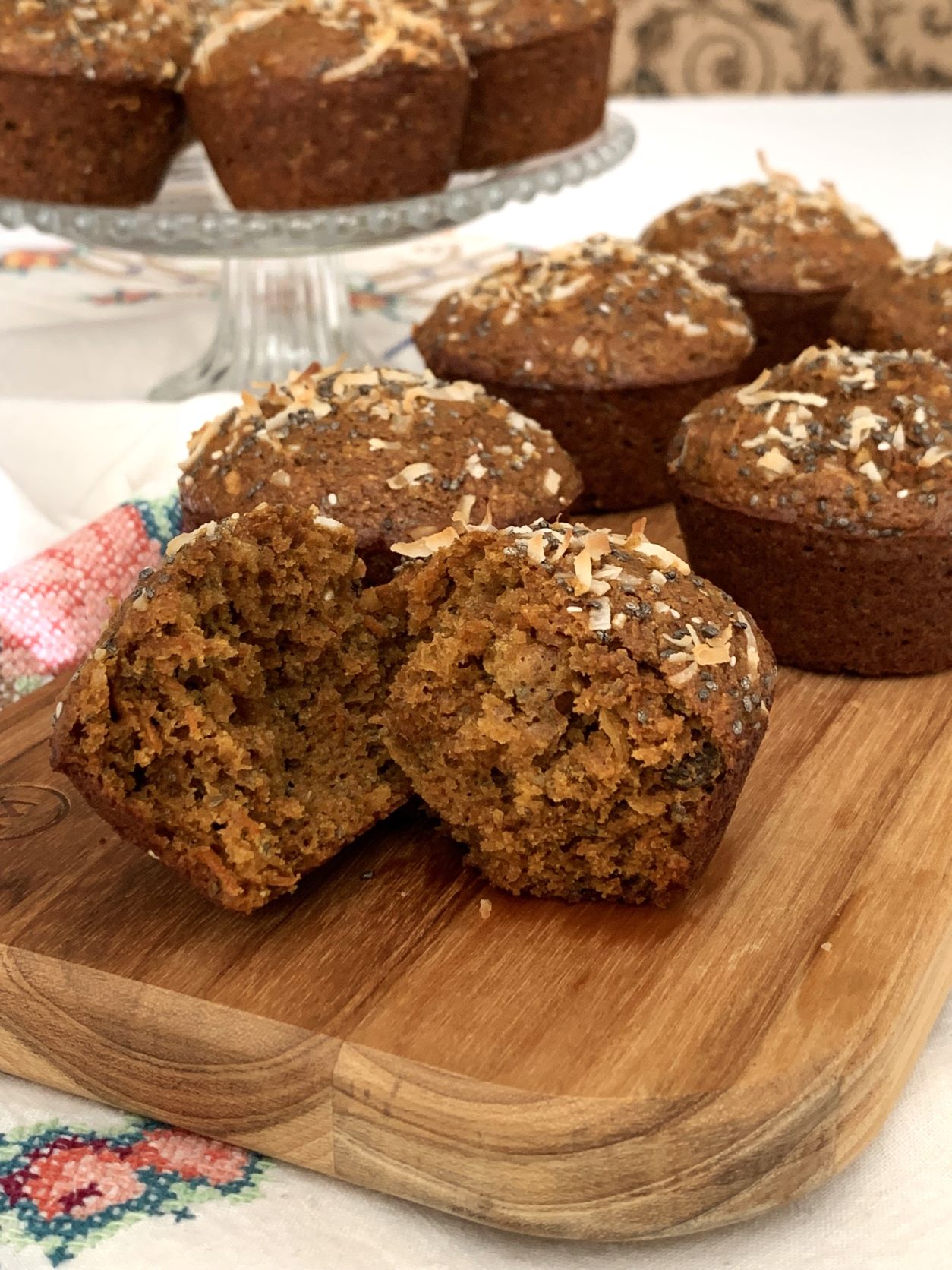
Turmeric Carrot Gingerbread Muffins

Okay, I looked up the recipe and saved it, and apparently my subconscious mind percolated and filtered through the recipe all night and into next day and finally I sat to think it through with my conscious mind. First off, I am not vegan, or vegetarian. Secondly, I don't have to be gluten free. So, I could make the recipe without those strictures, making it more a regular muffin recipe. I opted to use eggs. If milk was needed I would use it instead of a nut milk or coconut milk (I absolutely love coconut milk, but didn't want to open a can to use only a half cup!).

As it all turned out, I changed a lot of things. I truly didn't deviate much from the spirit of the recipe. I used almost everything in the recipe as stated, but changed amounts. 

  • I used a tiny bit more oil, but added a little snack cup of applesauce. 
    muffins, breakfast,  bread, ginger, turmeric, coconut, carrot, chia
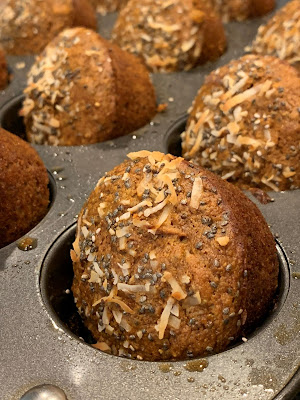
    Turmeric Carrot Gingerbread Muffins


  • I opted to not use maple syrup, as it is expensive and I can never tell by taste that it is even in a recipe like this. I waffled between using honey or agave syrup, then switched to molasses. 
  • Mixed spices were in the original recipe, and cardamom, cinnamon and nutmeg mentioned as possibilities. I changed this to cardamom and ground ginger. 
  • I used a fair bit more fresh ginger than called for as well, as I truly love ginger. 
  • As the recipe called for coconut milk and lemon juice, I changed that to buttermilk, thereby eliminating the lemon. Lemon would bring acidity up to work with the baking soda, but buttermilk will as well.
  • I used more flour, as I was adding both eggs and applesauce, so it was 2 cups of flour total. I used 1 cup of a mixture of barley and buckwheat flour, and the other cup plain all-purpose flour. If preferred, use all purpose flour for the whole 2-cup amount, or substitute whole wheat or other whole grain flour for part of the whole amount. In another attempt, I may use a bit of wheat bran as a part of the two cups of "flour."
I will caution that this recipe needs initial prep work, in that there are so very many little amounts of things to be measured out. I got out all my little cups I use for measuring out sets of spices and things (I save the little 1/2-cup applesauce snack containers for this type of use) and set out all the individual dry ingredients (mixed spices, raisins, coconut, chia, sugar, and the freshly grated ginger). I set the finely grated carrots in a bowl (Richa's recipe calls for blending carrots and other wet ingredients together, but I see no need for extra dirty utensils).

Ultimately, having used extra fresh ginger as well as adding dry ground ginger, along with the molasses, made these smell like the most heavenly gingerbread as they baked. All the extra textures and flavors, while not eclipsed completely, do give great texture. Carrots always make cakes moist, and that works here as well. These are exceptional muffins, and exceptionally good. Thank you Richa, for such an amazing combination!

Turmeric Carrot Gingerbread Muffins


Makes 12 muffins
muffins, breakfast, recipe, carrot, turmeric, coconut, chia, ginger
Turmeric Carrot Gingerbread Muffins


DRY INGREDIENTS:
1 cup all purpose flour (130 grams / 4.6 ounces)
1 cup whole grain or other flour, or simply use all purpose flour
1/2 teaspoon salt
2 teaspoons baking powder
1/2 teaspoon baking soda
3 tablespoons chia seed (32 grams / 1.15 ounce)
1/4 cup sugar or palm sugar (41 grams / 1.4 ounce)
1/4 cup raisins or chopped dates (34 grams / 1.2 ounce)
1/4 cup dry, unsweetened coconut shreds (18 grams / 0.65 ounce)

SPICES:
1 teaspoon ground cardamom seeds
1 teaspoon turmeric powder
1/2 teaspoon dry, ground ginger

WET INGREDIENTS:
2 carrots (155 grams / 5.25 ounces), finely grated
1/3 cup molasses
1/2 cup buttermilk
1/2 cup plain applesauce
2 tablespoons sunflower oil or coconut oil
1-inch fresh ginger, finely grated (15 grams / 0.55 ounce)
2 large eggs
--------
1 1/2 teaspoons each chia seed and shredded coconut for topping, optional
muffins, recipe, breakfast, carrots, chia seed, coconut, turmeric
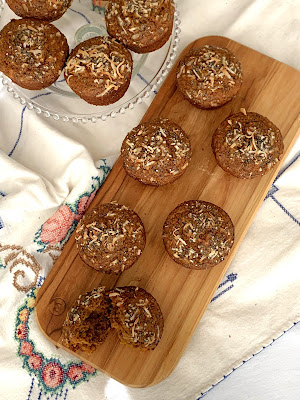
Turmeric Carrot Gingerbread Muffins


Preheat oven to 400 degrees. Grease, or spray with cooking spray, the wells of a 12-well muffin tin. Set aside.

This is easiest to first measure out all the little ingredients and have at hand, "mise en place." A personal choice, but recommended.

In a medium mixing bowl, place all the dry ingredients together, plus the spices and stir together.

In another bowl, combine all the wet ingredients and stir well to combine, then pour all the wet into the dry ingredients and mix with a spoon or silicone spatula until no dry ingredients remain. Fill the muffin tin wells equally - the mixture is very generous. Separately, sprinkle some of the coconut for topping over each portion of batter, then repeat with chia seed.

Bake the muffins for 12 to 15 minutes. Test with a toothpick, as for cakes, at about 12 minutes. Remove from oven and set aside to cool for 10 minutes before trying to remove from the tins. (Muffin papers may be used, if preferred.) After 10 minutes, the muffins will release from the tins with very little coaxing. Set them aslant in the wells to continue cooling. Store at room temperature for up to 2 days, or freeze some in zip-top freezer bags for another time.


My passion is teaching people how to create a harmony of flavors with their cooking, and passing along my love and joy of food, both simple or exotic, plain or fancy. I continue my journey in ethnic and domestic cuisines, continuing my journey to explore diverse culinary experiences and hopefully to start you on a journey of your own. Join me also at A Harmony of Flavors on Facebook, and Pinterest.

Saturday, January 19, 2019

My Indian Spice Drawer Part 4

Over the course of the last few days, I have showcased a lot of my spices, focusing in particular on those that I use in Indian cooking. Some are ones that are often mistaken for another, such as "caraway" (which is not used in Indian cooking at all, but much used in Europe and northern Africa) when what is really called for is Black Cumin, and poor Black Cumin gets called so many other things (like Nigella / Onion Seed / Kalonji), that it is nearly impossible to untangle without some sort of guideline to follow. In an effort to help with some of these many mistaken identities, and some just to introduce a spice you may not yet know, I have worked on these pages for clarification. 

I am not Indian. I have no particular Indian friends to help me out with this. I have, however, been cooking Indian foods for over 20 years now, and have run into a lot of unfamiliar words for things. I have spent countless hours poring over books and websites, trying to do this very same thing, and I feel at this point that I am fairly informed on the subject. 

But still. I have not been to the source. I have no one to correct me. I am going on my own hard work and effort over all these years, learning. Always learning. And as I love spices, I will likely learn of more, as time goes by. Meanwhile, I hope these pages will help someone out there.

Black Salt, kala namak, sulphur
Black Salt

Black Salt


A type of rock salt, salty and pungent, it is found mostly in the Himalayas. Black salt is comprised of several other components that give the salt its color (pink to purple) and smell (sulphur content). Though this salt can be produced from natural salts with the correct chemical compounds, it is commonly manufactured synthetically by adding ingredients and heating in a furnace. It is commonly used in Bangladesh, Nepal, India and Pakistan as a condiment added to things like chaats, chaat masalas, chutneys, raitas, salads and other Indian snacks. 

Some Indian names for Black Salt you may encounter: Kala Namak, Bire Noon, Kala Noon

~~~~~~~~~~~~~~~~~~~~~~~~~~~

Black Sesame Seed, sesame, whole seeds, spice,
Black Sesame Seed

Black Sesame Seed


(Sesamum Indicum ‘nigrum’)

Sesame seeds are all from the same plant, regardless of their color. Most commonly seen are white sesame, often on top of buns, but Black Sesame seeds have appeared more commonly over the years. In Indian cooking, they are cited specifically in an Assam sweet called “Til Pitha,” a thin cake with a black sesame and jaggery filling rolled inside. Some say that black sesame and white are the same except that the white have had the hull removed. Not entirely true. Possibly a polished black sesame seed would be white if its hull is removed, but white sesame seeds with their hull left on are a matte ivory beige in color (see below).

Some Indian names for Black Sesame Seed you may encounter:Til

~~~~~~~~~~~~~~~~~~~~~~~~~~~

White Sesame Seed, whole seed, unhulled seed, spice
White Sesame Seed

White Sesame Seed


(Shown unhulled, not polished)

(Sesamum indicum 'alba')

Sesame, sometimes known as Benne, may have originated in Africa. Many wild relatives are found in Africa and India. Sesame has one of the highest oil contents of any seed. Sesame oil (called “gingelly” oil in India) is used in many recipes, for "tempering" (adding spices and other flavors last minute to a dish that alone is relatively bland, like lentils) and general cooking. To date, I have not seen many sesame seeds of either black or white variety used in Indian recipes, except for sweets of various kinds, used like a peanut brittle. Sesame seeds appear to be used more in southern Indian foods.

Some Indian names for White Sesame Seed you may encounter:Til

~~~~~~~~~~~~~~~~~~~~~~~~~~~~

Star Anise, whole spice,
Star Anise

Star Anise, Chinese Star Anise


(Illicum verum)

Star Anise is the dried fruit of an evergreen tree indigenous to south eastern China. Produced almost entirely in China and Vietnam, there is small production in Arunachal Pradesh, in India. Generally considered an “exotic,” Star Anise can be used as an ingredient in Garam Masala and to flavor rice and meats. It is most often added whole to a dish and discarded before serving. It is often added to spiced masala chai mixtures and to most biryani dishes and slow cooked curries, potato dishes and garbanzo dishes. 


Some Indian names for Star Anise you may encounter: Badian, Badyani, Anasphal, Chakri Phool, Chakri Phul, Badal Phul

~~~~~~~~~~~~~~~~~~~~~~~~~~~

Black Stone Flower Lichen, dagad phool, tree lichen
Black Stone Flower Lichen

Stone Flower, Black Stone Flower 


(Parmotrema perlatum)

Typically used as a spice in Chettinad and West Indian (Maharashtrian) cuisines, Stone Flower, a type of lichen, has little flavor on its own and must be cooked in a little oil to release its flavor. The flavor is described as “strongly woody and with a cinnamon-like aroma and flavor.” It is typically used in meat dishes, some vegetable or lentil dishes (like my Punjabi Chole). Try it in Butter Chicken or Chicken Tikka.

Some Indian names for Stone Flower you may encounter: Dagad Phool, Kalpasi, Bojhwar, Raathi Pootha, Patthar ka Phool 

~~~~~~~~~~~~~~~~~~~~~~~~~~~~


Tamarind, pods, tree fruit, souring agent
Tamarind

Tamarind 


(Tamarindus indica)

A tree in the family Fabaceae, Tamarind is indigenous to tropical Africa, but has been cultivated for so long on the Indian subcontinent that it is considered by some to be indigenous there. The dried brown fruit pod contains dense, sticky, edible pulp surrounding black, shiny seeds which must be removed before use. The outer shell cracks off easily. The sticky fruit can be soaked for easier use. Tamarind is used most often in southern Indian cuisine and is considered a souring agent, like Mango Powder and dried Pomegranate Seeds (instead of using lemons or limes). Used most often in the southern parts of India, find it in many sauces for curries, vindaloo, sambar, lentils and dals, chutneys.

Some Indian names for Tamarind you may encounter: Imli, Amli

~~~~~~~~~~~~~~~~~~~~~~~~~


Turmeric Rhizome, fresh turmeric, powdered turmeric
Turmeric Rhizome

Turmeric 


(Curcuma longa)

More often seen in its bright yellow powdered form in the U.S., the vivid yellow orange rhizome (ginger family, Zingiberaceae) of this native of the Indian subcontinent and southeast Asia is known in many Asian cuisines, imparting strong yellow color and its warm, pungent, bitter, pepper-mustard-like flavor to savory dishes, though it lends color to widespread other products. In Indian cuisines, it is a usual component of curry powders, and commonly added to curries, masalas, pickles, dals, lentils, vegetables and many other foods to amp up color and flavors.

Some Indian names for Turmeric you may encounter: Haldi, Haldee, Huldi


My passion is teaching people how to create a harmony of flavors with their cooking, and passing along my love and joy of food, both simple or exotic, plain or fancy. I continue my journey in ethnic and domestic cuisines, continuing my journey to explore diverse culinary experiences and hopefully to start you on a journey of your own. Join me also at A Harmony of Flavors on Facebook, and Pinterest.

Disqus